You hear it right now, don't you? That high-pitched ring, hiss, or buzz that never fully goes away — louder in a quiet room, worse after a bad night's sleep. You earned it on the flight line, in the turret, on the range, or next to a generator that ran all night. And when you finally filed for it, the VA handed you 10% and called it a day.
Here's the frustrating part most veterans never get told: 10% is the ceiling for tinnitus. There is no 20%, no 30%, no "it's in both ears so it's worth more." One rating, 10%, full stop. That feels like a slap when the ringing runs your life. But that single number is also one of the most powerful doors in the entire VA system — because of what it lets you stack next to it.
This guide breaks down exactly why tinnitus caps at 10%, how the VA actually rates it, why hearing loss is rated separately (and how to claim both), and the AVOY way to organize these claims before you file so you walk away with every percentage point you earned.
The Problem: Why Tinnitus Is "Only" 10% — and Why That's Not the Whole Story
Tinnitus is the perception of sound — ringing, buzzing, hissing, clicking, roaring — when no outside sound is making it. It's not "in your head" in the dismissive sense. It's one of the most common service-connected disabilities in America, because military service is loud: weapons, aircraft, armor, engines, explosions. Hearing damage and tinnitus travel together.
The VA rates tinnitus under 38 CFR § 4.87, Diagnostic Code 6260. Here is the part that trips veterans up: the rule was clarified back in 2003 to say that tinnitus gets a single 10% rating, period — whether you hear it in one ear, both ears, or "in your head." You cannot get one rating for the left ear and another for the right. The Board of Veterans' Appeals has shot down that argument hundreds of times. There is simply no legal path to a schedular rating higher than 10% for tinnitus by itself.
Tinnitus rating at a glance (DC 6260)
| Diagnostic Code | Condition | Rating | Key rule |
|---|---|---|---|
| 6260 | Tinnitus (recurrent) | 10% | Single 10% maximum — one rating whether unilateral, bilateral, or "in the head." |
| 6260 | Tinnitus | 0% | Not assigned in practice — once service-connected and recurrent, it's 10%. |
A heads-up worth knowing in 2026: the VA has proposed folding tinnitus into the condition that causes it (like hearing loss or TBI), rather than rating it on its own. That proposal is not in effect as of this writing — DC 6260 still stands, and tinnitus is still its own 10% rating. And critically, the VA has said that veterans who already hold a tinnitus rating would be grandfathered — your existing 10% would be protected. The takeaway: if tinnitus is even on the table for you, getting it documented and claimed now is smart.
Why so many tinnitus claims still get denied
If 10% is automatic once it's granted, why do veterans get denied at all? Three reasons, over and over:
- No nexus to service. You need to connect the ringing to something that happened in service. "I was around loud stuff" isn't enough on paper — the VA wants to see the link.
- Silence in the record. Tinnitus is subjective. There's no blood test for it. If you never mentioned it and never had a buddy who can vouch for it, the examiner may write it off.
- A weak or rushed C&P exam. The exam for tinnitus is short, and a single "less likely than not" opinion from the examiner can sink the claim — even when your history clearly supports it.
The piece veterans miss: hearing loss is rated separately
This is where the real money lives. Tinnitus and hearing loss are two different claims, with two different diagnostic codes. Tinnitus is DC 6260 (the flat 10%). Hearing loss is rated under DC 6100, and it can range anywhere from 0% all the way to 100%, depending on how bad the loss is.
Hearing loss isn't rated on how you feel — it's rated by the numbers from an audiology exam. The audiologist measures two things: your puretone thresholds (how loud a tone has to be before you hear it, averaged across 1000, 2000, 3000, and 4000 Hz) and your speech recognition using the Maryland CNC word-list test. Those two numbers get plugged into the VA's tables (Table VI assigns a Roman numeral to each ear; Table VII combines both ears into a percentage).
| Diagnostic Code | Condition | Rating range | How it's measured |
|---|---|---|---|
| 6100 | Hearing loss (both ears) | 0%–100% | Puretone threshold average + Maryland CNC speech test → Table VI → Table VII |
| 6260 | Tinnitus | 10% (flat) | Service connection + recurrent symptoms; no measurement scale |
Most veterans' hearing loss rates at 0% or 10% at first — but here's the point: a 0% hearing loss rating is still a win. It's a service-connected condition on your record. It can climb over time as your hearing worsens, and it pairs with your tinnitus and opens the door to other secondary claims. Filing them together is how you stop leaving money on the table.
The AVOY System: Organize Before You File, Then Stack
At AVOY we teach one core idea: don't file a claim — build a case. Tinnitus is the perfect example, because the smart move isn't to chase a higher tinnitus number that doesn't exist. The smart move is to treat tinnitus as the anchor of a cluster of related claims and organize all of them before a single form goes in.
Step 1 — File the Intent to File first
Before you do anything else, lock your date. A VA Form 21-0966 (Intent to File) takes two minutes and freezes your effective date for up to a year. If your claim is granted later, your back pay is calculated from the Intent to File date — not the day you finally finished gathering evidence. File it, then take your time building the case right.
Step 2 — Build the nexus for tinnitus
You need to connect the ringing to service. The strongest tinnitus claims include:
- Your MOS and duty history showing noise exposure (infantry, artillery, aviation, armor, motor pool, military police, construction, flight deck — anything loud).
- A one-page personal statement in your own words: when the ringing started, how it has continued ever since, and how it affects sleep, focus, and daily life. Consistency matters more than fancy words.
- A buddy statement from someone who served with you or who has watched you struggle with the ringing since you got out.
Step 3 — Claim hearing loss at the same time
Request the audiology exam and file hearing loss (DC 6100) alongside tinnitus. Even if it comes back at 0%, you've now got it service-connected and on the record. Bring any old hearing tests, civilian audiology results, or notes about asking people to repeat themselves — anything that shows the loss is real and ongoing.
Step 4 — Stack the secondaries tinnitus quietly causes
This is the part law-firm blogs rarely spell out. Severe, chronic tinnitus doesn't just ring — it wrecks sleep, fuels anxiety, and grinds people down. When that's documented, you may have grounds for secondary claims, which can carry far higher ratings than the 10% tinnitus itself:
- Insomnia or a sleep disorder secondary to tinnitus — when the ringing keeps you from falling or staying asleep.
- Anxiety or depression secondary to tinnitus — when the constant noise drives a documented mental-health condition. Mental-health ratings run 0%, 10%, 30%, 50%, 70%, and 100%.
- Migraines or headaches tied to the same acoustic trauma or to the tinnitus itself.
Each of those needs its own nexus — a medical opinion linking it back to the tinnitus — but this is exactly how a "measly" 10% becomes the foundation of a much larger combined rating. And remember, the VA combines ratings with VA math, not regular addition, so it's worth understanding how each new condition actually moves your number.
The AVOY bottom line: Stop trying to beat the 10% tinnitus cap. Instead, anchor your tinnitus, attach hearing loss, and stack the sleep and mental-health secondaries it causes. That's how organized veterans turn one small rating into real, lasting compensation.
Your Access Point: Free Tools, the Navigator, and the Book That Goes Deeper
You don't have to figure this out alone, and you don't have to pay a 20% contingency fee to anyone to do it. Here's how to take the next step today.
📋 Get the Free VA Evidence Checklist →
Ask the Navigator. Not sure whether your sleep problems or anxiety qualify as secondary to tinnitus? Visit www.avoyvet.com and ask AVOY Veteran Navigator AI™ for educational guidance on tinnitus, hearing loss, secondary conditions, and how to organize your claim before you file. It's built on the same system in this library and answers in plain English, any time of day.

RECOMMENDED READING
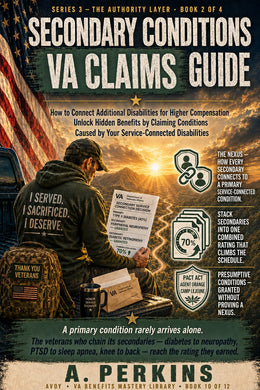
Secondary Conditions VA Claims Guide
The hidden money most veterans never claim. How to connect tinnitus, hearing loss, sleep, and mental-health conditions for a higher combined rating — with the nexus and evidence strategy spelled out step by step.
Get the Book →Keep reading: VA Secondary Conditions: What Else You Can Claim · Sleep Apnea Secondary to PTSD · How VA Math Really Works
Frequently Asked Questions
Can I get more than 10% for tinnitus?
No. Under Diagnostic Code 6260, tinnitus is capped at a single 10% rating, whether you hear it in one ear, both ears, or in your head. The way to increase your compensation is to claim hearing loss separately and to stack secondary conditions like insomnia, anxiety, or depression that the tinnitus causes.
Is tinnitus rated separately from hearing loss?
Yes. Tinnitus is rated under DC 6260 (a flat 10%), and hearing loss is rated under DC 6100, which can range from 0% to 100% based on an audiology exam. They are two separate claims, and you should file both — they commonly come from the same noise exposure in service.
Why did the VA only give me 0% for hearing loss?
Hearing loss is rated by your puretone threshold averages and your Maryland CNC speech-recognition score, not by how you feel. Many veterans start at 0% or 10%. A 0% rating is still a service-connected win — it's on your record, it can increase as your hearing worsens, and it supports related claims.
Can tinnitus lead to a higher overall rating?
Often, yes — indirectly. Chronic tinnitus frequently causes documented insomnia, anxiety, or depression. Those secondary conditions carry their own ratings (mental-health conditions run as high as 100%), so an organized claim built around tinnitus can produce a much higher combined rating than the 10% alone.
Is the VA getting rid of the tinnitus rating?
The VA has proposed folding tinnitus into the condition that causes it, but that change is not in effect as of 2026 — DC 6260 still stands. The VA has indicated that veterans who already hold a tinnitus rating would be grandfathered and protected, which is one reason to get it documented and claimed now.
Educational information only — not legal, medical, or financial advice, and not claim representation. AVOY is not affiliated with or endorsed by the U.S. Department of Veterans Affairs. Filing a VA claim is free, and a VA-accredited Veterans Service Officer (VSO) can help you at no cost. In crisis? Dial 988, then press 1.