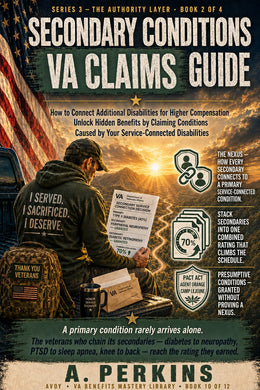
If you already have a service-connected condition, you may be leaving benefits on the table. Many conditions cause or worsen others over time, and those follow-on conditions can be claimed too. They are called secondary conditions, and they are one of the most overlooked ways veterans raise their overall rating.

What is a secondary condition?
A secondary condition is a new condition that is caused or aggravated by a condition the VA already recognizes as service-connected. Because the primary is already tied to your service, you do not have to prove the original in-service event again — you have to prove the link between the primary and the new condition.
Common examples (educational, not guarantees)
Every veteran is different, and only a licensed provider can say whether a link applies to you. But these are patterns veterans and clinicians commonly discuss:
- PTSD or mental health connected to sleep apnea, hypertension, GERD, or migraines.
- Tinnitus connected to migraines or anxiety.
- A knee or back injury connected to the opposite joint (from favoring one side) or to depression from chronic pain.
- Medication side effects from a service-connected condition that create a new diagnosable problem.
How to prove a secondary condition
Two pieces do the heavy lifting: a current diagnosis of the secondary condition, and a nexus — a licensed provider’s opinion that the secondary is “at least as likely as not” caused or worsened by your service-connected primary. Document the severity of the secondary just like any other claim, because it carries its own rating.
Map your secondary conditions — free
Not sure what might connect to your service-connected conditions? Use the free AVOY Secondary Conditions Map to explore common links and see which ones may be worth discussing with your provider.
Then bring your list to AVOY Veteran Navigator AI for an educational roadmap on documenting and sequencing them.
Important disclaimer — educational use only (tap to expand)
Educational information only — not legal, medical, or claim representation, and not affiliated with the U.S. Department of Veterans Affairs. For help filing or appealing, contact a VA-accredited VSO (often free), claims agent, or attorney. For current rates, forms, and deadlines, see VA.gov.