If the VA denied your sleep apnea claim, you are not crazy and you are not alone. This is one of the conditions the VA fights hardest. Veterans get that brown envelope, read the word "denied," and figure that's the end of it. It isn't. Most of these denials happen for one reason: the claim was filed wrong, not because the veteran didn't deserve it. Let me walk you through exactly how sleep apnea secondary to PTSD works, how the VA rates it, why it gets denied, and how to build the claim the right way the first time.
Beat 1 — Why the VA Loves to Deny Sleep Apnea (and Why That's Not the End)
Here's the frustration I hear over and over: "I have PTSD, I can't sleep, I stop breathing at night, my doctor put me on a CPAP machine — and the VA still told me no." You feel like you're being punished for telling the truth.
What's really going on is that sleep apnea is one of the most-claimed conditions in the VA system, so the VA scrutinizes it hard. When you file it as a "secondary" condition — meaning your service-connected PTSD caused or worsened it — the VA wants a clean, documented chain connecting the two. Most veterans never build that chain. They file the claim, hope the VA connects the dots, and the VA doesn't. That's the whole game right there.
The good news: sleep apnea is also one of the most winnable claims once you understand what the VA is actually looking for. Organize before you file, and this stops being a coin flip.
What sleep apnea is, in plain English
Sleep apnea means you stop breathing — over and over — while you sleep. Your body jolts awake just enough to start breathing again, sometimes dozens of times an hour. You never get deep, restful sleep, so you're exhausted all day. The most common type is obstructive sleep apnea, where the airway collapses. The most common treatment is a CPAP machine, which pushes air through a mask to keep your airway open.
How PTSD is connected to sleep apnea
This is the part the VA doesn't volunteer. There is real, published medical research showing that PTSD can cause or worsen sleep apnea. PTSD wrecks your sleep architecture, drives chronic stress hormones, fragments your breathing patterns at night, and is tied to weight gain from medication and inactivity — all of which feed sleep apnea. That's the medical bridge your claim has to stand on. Under 38 CFR § 3.310, if a service-connected condition (your PTSD) causes or aggravates another condition (your sleep apnea), that second condition can be service-connected too — and you do not have to prove the sleep apnea started during your service. You only have to connect it to the PTSD. (For the bigger picture on what else you can claim this way, read VA Secondary Conditions: What Else You Can Claim.)
How the VA rates sleep apnea — Diagnostic Code 6847
The VA rates sleep apnea under 38 CFR § 4.97, Diagnostic Code 6847. There are four levels, and they are not based on how miserable you feel — they're based on treatment and severity:
| Rating | What it takes to get it (DC 6847) |
|---|---|
| 0% | Diagnosed sleep apnea, but no real symptoms and no treatment required. |
| 30% | Persistent daytime hypersomnolence — you're constantly drowsy and exhausted during the day. |
| 50% | Requires the use of a breathing assistance device such as a CPAP machine. This is the big one most veterans land on. |
| 100% | Chronic respiratory failure with carbon dioxide retention, a tracheostomy, or cor pulmonale (right-side heart failure from lung disease). |
Read that 50% row again. Under the current rules, if a doctor prescribes a CPAP machine for your sleep apnea, that's a 50% rating. Not because of how often you use it — because it's prescribed. For a single veteran with no dependents, a 50% rating pays $1,132.90 a month in 2026 (the rates went up 2.8% effective December 1, 2025). A 30% rating pays $552.47, and a 100% rating pays $3,938.58. Those dependent-included amounts go higher.
Important timing note. The VA has been trying to change these rules for years (a proposed rule went out in 2022, and a supplemental notice followed in 2024). The proposed version would remove that automatic 50% for a CPAP prescription and tie the rating to functional impairment instead. As of late 2025 it was not final, so the current criteria above still apply — and veterans rated under the current rules are expected to be grandfathered in. Translation: do not sit on this claim. File it under the rules that exist today.
Why these claims get denied
Three reasons account for almost every sleep apnea secondary denial:
(If you've already been turned down, start with Why Was My VA Claim Denied? to pinpoint which of these hit you.)
Number one: no sleep study. The VA will not accept "my doctor said I have sleep apnea." They require a polysomnography — a formal sleep study — to confirm the diagnosis. No sleep study, no rating, full stop.
Number two: no nexus. You have PTSD, you have sleep apnea, but nothing in your file explains why one caused the other. The VA is not going to make that argument for you. If there's no medical opinion connecting them, they deny.
Number three: PTSD isn't service-connected yet. Secondary claims hang off a primary, service-connected condition. If your PTSD hasn't been granted, there's nothing for the sleep apnea to attach to.
Beat 2 — The AVOY System: How to Build This Claim So It Wins
OK. Here's how I'd actually do it. This is the part the law-firm blogs won't lay out for you, because their model depends on you handing them a third of your back pay. You can build most of this yourself.
Organize before you file. That's the whole philosophy. Veterans lose because they file fast and messy. Winners file slow and clean. Get all your pieces in one folder before a single form goes in.
Step one — lock your date with an Intent to File. Go to VA.gov and file an Intent to File (VA Form 21-0966) before you do anything else. It takes two minutes. It freezes your effective date, so when your claim is approved months later, your back pay is calculated from today — not from the day you finally finished gathering evidence. This one step protects up to a year of back pay. Most veterans skip it. Don't.
Step two — get the sleep study. If you've never had a formal sleep study, that's your first move. Ask your doctor for a referral to a sleep clinic, or get one through the VA. The polysomnography report is the spine of the whole claim. If you already have a CPAP, you almost certainly had a study — get that report into your hands.
Step three — confirm your PTSD is service-connected. If it already is, good, you have your anchor. If it isn't yet, file the PTSD claim too. And here's the strategy: don't file one thing and wait. When I went through this, I filed ten claims at once — primary conditions and their secondaries together, on a single VA Form 21-526EZ. Filing them together gives all of them the same effective date and one clean back-pay calculation, instead of dribbling claims out one at a time over years. (Here's the full method: How to File Multiple VA Claims at Once.)
Step four — write a short, honest impact statement. For the sleep apnea, write one page. Not five — one. Say what you're claiming, that it's secondary to your service-connected PTSD, and how it hits you today: the exhaustion, falling asleep during the day, the effect on your job, your marriage, your ability to function. Plain language, your words, kept to a page. Short statements get read. Ten-page statements get skimmed.
Step five — document your symptoms with real data. Don't just say you're tired. Show it. When I built my claims, I used my Apple Watch sleep and health data to document what was actually happening at night. Anything that turns "I feel bad" into a record helps — a sleep log, your CPAP compliance data, your watch.
Step six — get the nexus. This is the difference-maker. A nexus letter is a written opinion from a qualified medical provider saying your sleep apnea is "at least as likely as not" caused or aggravated by your PTSD, with the medical reasoning and supporting research behind it. "At least as likely as not" is the exact legal standard — 50/50 or better. When I filed, I had a former military physician review my conditions and write a favorable opinion with a nexus for each one. That independent medical opinion is what turns a denial into an approval. Attach it, attach the sleep study, attach any prior VA or Board decisions that line up with your facts, and attach the supporting medical research on the PTSD–sleep apnea link.
One thing I want to be clear about: I'm not telling you to "go get a C&P exam." A C&P is the VA's exam — they schedule it, not you. The point of building your own evidence — the sleep study, the impact statement, the data, and the nexus from your own doctor — is so you walk in strong and aren't at the mercy of whatever a rushed VA exam concludes.
Stack your secondaries
While you're at it, think about what else connects. Veterans with PTSD and sleep apnea often also have conditions secondary to those — and each one is its own rating that combines into your total. This is exactly why you organize everything before you file: so you claim the whole picture at once, with one effective date, instead of leaving money and years on the table.
Beat 3 — Your Next Step
You don't have to figure this out alone, and you don't have to give up a third of your back pay to a firm to do it right.
Get the Free VA Evidence Checklist →
It walks you through every document the VA wants for a secondary claim — including sleep apnea — so nothing gets left out of the folder.
Have a specific question right now? Ask the free AVOY Veteran Navigator at avoyvet.com/pages/start. Type your situation in plain English — "sleep apnea secondary to PTSD, denied once" — and get educational guidance on your next steps, any time of day.

Recommended Reading
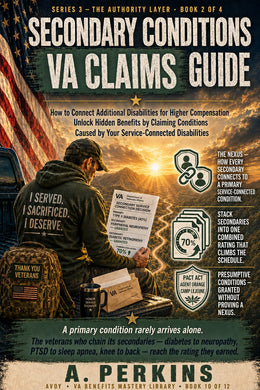
Secondary Conditions VA Claims Guide — the AVOY guide to connecting and stacking the conditions the VA hopes you'll never claim, with the evidence and nexus strategy laid out step by step. Get the book →
Frequently Asked Questions
Can I get sleep apnea service-connected secondary to PTSD?
Yes. Under 38 CFR § 3.310, if your service-connected PTSD caused or aggravated your sleep apnea, the sleep apnea can be service-connected as a secondary condition. You need a current diagnosis confirmed by a sleep study, a service-connected PTSD rating, and a medical nexus opinion linking the two.
What rating will I get for sleep apnea?
Under the current rules (Diagnostic Code 6847), a prescribed CPAP or other breathing assistance device rates at 50%. Persistent daytime sleepiness without a device rates at 30%, and the most severe respiratory cases rate at 100%. A 50% rating pays $1,132.90 a month in 2026 for a single veteran with no dependents.
Do I really need a sleep study?
Yes. The VA will not grant the claim on a doctor's say-so alone — they require a polysomnography (formal sleep study) to confirm the diagnosis. If you use a CPAP, you almost certainly already had one; get that report.
What is a nexus letter and why does it matter so much?
It's a written medical opinion stating your sleep apnea is "at least as likely as not" caused or aggravated by your PTSD, with the medical reasoning behind it. It's the single biggest reason these claims are won or lost, because it's the evidence that actually connects the two conditions for the VA.
Should I file now or wait for the new sleep apnea rules?
File now. The VA has proposed changing the rules to remove the automatic 50% for a CPAP, but as of late 2025 that wasn't final. Veterans rated under the current rules are expected to be grandfathered, so filing under today's criteria protects you.
This article is educational only and is not legal, medical, or financial advice, and is not claim representation. AVOY is not affiliated with or endorsed by the U.S. Department of Veterans Affairs. Filing a VA claim is free, and a VA-accredited Veterans Service Officer (VSO) can help you at no cost. In crisis? Dial 988, then press 1.