On August 19, 2026, the U.S. Court of Appeals for Veterans Claims approved a settlement that forces VA to go back through decades of wrongly closed appeals — some dating to 1990 — reactivate the valid ones, and put them back on the Board's docket at their original filing date. If VA ever closed your appeal because it said you never filed a Substantive Appeal, this order is about you, and you are already in the class whether you know it or not.
The Problem: A Computer Quietly Closed Tens of Thousands of Appeals
Here is what happened, in plain English.
VA used to track appeals in an old computer database called VACOLS — the Veterans Appeals Control and Locator System. When a veteran disagreed with a decision, VA sent back a Statement of the Case. To keep the appeal alive and get it in front of the Board of Veterans' Appeals, the veteran then had to send in one more form: the Substantive Appeal (most veterans know it as VA Form 9).
If that form did not show up on time, VACOLS had an automatic feature that swept the appeal closed. The problem: the sweeper also closed appeals where the veteran had filed on time. The form was in the file. The computer closed the case anyway. And in many cases, nobody told the veteran. Their appeal simply stopped existing.
Two people pushed back. On June 21, 2021, veteran J. Roni Freund and Mary S. Mathewson — the surviving spouse of veteran Marvin Mathewson — filed a petition arguing VA had wrongly closed their appeals this way. VA reactivated their two individual appeals and argued the case was over. The Federal Circuit disagreed, and in 2024 sent it back. On March 18, 2026, the court certified a class action. On August 19, 2026, the court approved the settlement and closed the case.
Who is in the class
The court defined the class as all claimants with an appeal file in VACOLS that was closed between December 12, 1990, and February 6, 2025, for lack of a timely filed Substantive Appeal, and which remains closed. Surviving family members who substituted in — or are eligible to substitute in — for a class member are covered too.
Two important limits: this only covers VA's old "legacy" appeals system, which means VA decided your claim before February 19, 2019 and issued you a Statement of the Case. And it only covers the Substantive Appeal — no other VA form puts you in this class.
What VA now has to do
| VA's Obligation | The Number |
|---|---|
| Appeal files VA must review by hand, looking for a timely Substantive Appeal | 28,258 |
| Additional closed files where VA must mail an individualized notice of the right to request review | up to 64,599 |
| Deadline to finish the reviews, reactivations, and notices | under 18 months from approval |
| Docket position for a reactivated appeal | The date of your original Substantive Appeal — not today's date |
| Right to opt out | None. The class is mandatory — but the court found it can only help you, never hurt you |
That fourth row is the money. Your reactivated appeal goes back in line at the date you originally filed. If the appeal then wins, the effective date reaches back to the original claim — which for a 1990s appeal can mean decades of retroactive compensation.
One thing the settlement does not do: the court overruled an objection asking for the back pay to be adjusted for inflation and interest, noting that adding interest against the government would likely have been unlawful. You get what the rating schedule owed you then, not an inflation-adjusted version of it.
The AVOY System: What to Do Right Now
VA says you are not required to do anything. That is technically true and practically bad advice — VA is only hand-reviewing 28,258 files out of a much larger pool, and it found those by searching its own records for documents that look like a Substantive Appeal. If your Form 9 was scanned in badly, mislabeled, or filed on paper before VA digitized it, the search may have missed you entirely. Veterans who raise their hand get reviewed. Veterans who wait may not.
| Step | What to Do |
|---|---|
| 1. Check the dates first | Did VA decide your claim before February 19, 2019? Did you receive a Statement of the Case? If both are yes, you were in the legacy system and this can apply to you. |
| 2. Look for your Form 9 | Search your own records for a Substantive Appeal (VA Form 9) you sent within one year of the decision or 60 days of the Statement of the Case. A mailing receipt, fax confirmation, or dated copy is gold. |
| 3. Request your C-file | Your claims file shows what VA actually has. If the Form 9 is sitting in there and the appeal is still closed, that is the exact fact pattern this settlement was built to fix. |
| 4. Raise your hand in writing | The settlement lets any class member affirmatively ask VA to review their case. Class counsel is John D. Niles at Carpenter Chartered — freundclass@carpenterchartered.com, or P.O. Box 2099, Topeka, KS 66601, Attn: Freund Inquiry. Reference "Freund, 21-4168." |
| 5. Watch your mailbox and update your address | VA is mailing up to 64,599 individualized notices. If VA has a twenty-year-old address for you, you will never see yours. Update it at VA.gov today. |
| 6. Do not pause your current claim | A reactivated legacy appeal is separate from anything you have pending now. Keep filing, keep building evidence, keep your effective dates protected. |
| 7. Rebuild the evidence file | An appeal from 1997 gets reactivated with 1997's evidence. Start gathering records, buddy statements, and a medical nexus opinion now so the appeal is ready when it moves. |
This is the organize-before-you-file principle applied backward in time. The veteran who has the Form 9 copy, the C-file, and a clean written request is the one who gets reviewed and paid. The veteran who assumes the system will find them is trusting the same database that closed the appeal in the first place.
The Access Point
Start building your file today with these free tools:
Get the Free Evidence Checklist →
Ask AVOY Veteran Navigator AI™ →
Recommended Reading

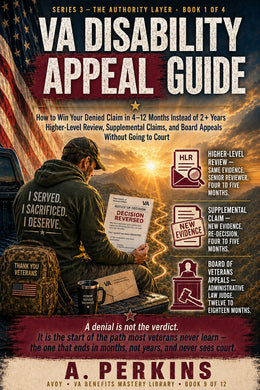
The VA Disability Appeal Guide: Win Your Denied Claim Without Going to Court
How to read a denial, choose the right lane, build the evidence VA actually wants, and win in months instead of years — the complete appeals playbook for veterans who were told no.
Get the Book →Frequently Asked Questions
What exactly is a Substantive Appeal?
It was the filing in VA's old legacy system — usually VA Form 9 — that moved your case up to the Board of Veterans' Appeals after VA sent you a Statement of the Case. You generally had one year from the original decision or 60 days from the Statement of the Case to send it in. No other VA form puts you in the Freund class.
Am I in the class?
You are a class member if VA closed your appeal file in VACOLS between December 12, 1990 and February 6, 2025 because it said you did not file a timely Substantive Appeal, and that appeal is still closed. Surviving family members who substituted in, or can substitute in, are also covered. Because VA decided the underlying claim before February 19, 2019 in every legacy case, newer AMA-system claims are not included.
Can I opt out?
No. The settlement has no opt-out provision, and the court upheld that — it found the agreement can only benefit class members, never disadvantage them. If a reactivated appeal turns out to be something you no longer want to pursue, you can withdraw it at VA at that point.
How far back can the money go?
A reactivated appeal returns to the Board's docket at the date of your original Substantive Appeal. If it wins, the effective date runs from the original claim — which for appeals closed in the 1990s can mean decades of retroactive compensation. The exact amount depends entirely on your rating and your dates.
Will I get interest or an inflation adjustment on the back pay?
No. One class member objected and asked for exactly that. The court overruled the objection, noting that awarding interest against the federal government in this posture would likely have been unlawful.
How long does VA have?
Under 18 months from approval to complete the manual reviews, the reactivations, the notifications, and the mailing of individualized notices — and the settlement requires VA to then process reactivated cases expeditiously.
Do I need to pay a lawyer to be included?
No. There is nothing to buy and nothing to sign up for. Filing and pursuing a VA claim is always free, and a VA-accredited Veterans Service Officer can help you at no cost. Class counsel already represents the class.
Related Reading
- How to Read Your VA Decision Letter (Line by Line)
- How to Appeal a VA Denial Letter: A Veteran's Step-by-Step Guide
- My VA Claim Was Denied — Exactly What to Do in the Next 30 Days
This article is for educational purposes only and is not legal, medical, or financial advice, and does not constitute claim representation. AVOY is not affiliated with or endorsed by the Department of Veterans Affairs. Filing a VA disability claim is always free, and a VA-accredited Veterans Service Officer (VSO) can help you at no cost. In crisis? Dial 988, then press 1.
Sources: Freund v. Collins, U.S. Court of Appeals for Veterans Claims, No. 21-4168, per curiam order approving class settlement, filed August 19, 2026. VA Office of General Counsel, "Notice of proposed settlement agreement for VA benefits claimants whose timely, substantive appeals have not been processed," VA News, April 15, 2026.