You opened the envelope. It said "denied." Your stomach dropped.
Take a breath. A denial is not a verdict. It is a first draft of an opinion — written by a rater who had only the pile of paper in front of them. Most denials I see are not because the veteran was wrong. They are because the file was thin, disorganized, or missing one specific link. That is fixable. And you have a full year to fix it.
But the next 30 days matter more than the eleven months after them. This is the window where you find out why you were denied, gather what was missing, and choose the right lane. Do this part right and your second decision often comes back approved — with back pay all the way to your original filing date.
Here is the exact plan.
The Problem: You Were Denied, and the Letter Doesn't Really Say Why
The VA decision letter is a strange document. It is long, it repeats itself, and the single sentence that actually explains your denial is buried on page four next to a wall of regulation citations. Most veterans read "service connection for [condition] is denied" and stop there. Then they either give up, or they re-file the exact same claim with the exact same evidence — and get denied again.
Both of those are losing moves. Understand this: the VA did not reject you. It rejected the file. Your job is to figure out which piece of the file failed.
The Three Legs of Service Connection
Almost every direct service-connection claim stands on three legs. Knock one out and the whole thing falls over.
- A current diagnosis. A doctor, today, has written down that you have the condition.
- An in-service event, injury, or exposure. Something happened while you served.
- A medical nexus. A medical opinion that links leg 1 to leg 2 — that your condition is "at least as likely as not" related to service.
Your denial letter is telling you which leg broke. You just have to translate it.
Denial-Reason Decoder: What the Letter Says vs. What It Means
| What the letter says | What actually broke | What fixes it |
|---|---|---|
| "The evidence does not show a current disability." | Leg 1 — no diagnosis in the file, or it's an old one | Get a current, dated diagnosis from a treating provider (VA or private) |
| "Your service treatment records are silent for…" | Leg 2 — nothing in your STRs shows the event | Buddy statements, your own lay statement, unit records, personnel file, deployment orders |
| "The evidence does not establish a relationship between your condition and military service." | Leg 3 — the nexus. This is the #1 denial reason. | A nexus letter / independent medical opinion (IMO) using the "at least as likely as not" standard |
| "You failed to report for your scheduled examination." | You missed the C&P exam | Explain good cause and ask to be rescheduled — often fixable fast |
| "Your condition is not shown to be compensable / rated 0%." | You won service connection but the severity evidence was thin | This is not a denial — it's a lowball. File for an increase with symptom-frequency evidence |
| "Not related to your service-connected condition." | Secondary nexus missing | A medical opinion tying the new condition to the already-rated one |
Circle the sentence in your letter. Match it to the table. Now you know what you are actually fighting about — and you are already ahead of 90% of veterans who re-file blind.
The Clock: One Year, and Why Day 1 Matters
You have one year from the date on your decision letter to file any of the three review options. Not from the day you opened it. From the date printed on it.
Miss that year and your decision becomes final. You can still file a Supplemental Claim after the year is up — but you lose the protected effective date, and your back pay starts over from the new filing date instead of the old one. On a 70% rating, that can be tens of thousands of dollars. (See our breakdown of VA back pay and effective dates.)
So: the year is your ceiling. Thirty days is your working sprint.
The Three Lanes: Choosing Where to Send It
Since the Appeals Modernization Act, there are exactly three review lanes. Picking the wrong one is how veterans lose another year for nothing.
| Lane | Form | New evidence? | Who reviews it | VA's stated goal | Use it when… |
|---|---|---|---|---|---|
| Supplemental Claim | VA Form 20-0995 | Yes — required. Must be "new and relevant." | A claims adjudicator (fresh look) | ~125 days average | Something was missing. You now have a nexus letter, a new diagnosis, buddy letters, or private records. |
| Higher-Level Review | VA Form 20-0996 | No. Same evidence only. | A senior reviewer | ~125 days average | The evidence was already there and the rater got it wrong — misread a record, ignored a favorable opinion, applied the wrong diagnostic code, or blew the duty to assist. |
| Board Appeal | VA Form 10182 | Depends on docket (Direct Review = no; Evidence Submission = yes, within 90 days; Hearing = yes) | A Veterans Law Judge | ~365 days (Direct Review); ~550 days (Evidence Submission) | You've already tried a lower lane, or the issue is legal/complex and you want a judge. |
Processing times shift regularly based on VA's current workload — the figures above are historical averages, not a guarantee. Confirm today's estimated timeline for your lane at VA.gov before you file. (For reference: VA's overall disability/pension claims backlog fell below 70,000 in July 2026 — the lowest it's been since February 2020 — so wait times across the system have been trending down.)
The plain-English rule I give every veteran:
- Missing something? → Supplemental Claim. Add the piece and send it back.
- They missed something? → Higher-Level Review. Point at the mistake and ask for the informal conference.
- Both lanes failed, or the law itself is the fight? → Board Appeal.
One more thing most veterans don't know: the Higher-Level Review lets you request an informal conference — a phone call with the senior reviewer where you (or your representative) get to say, out loud, "look at page 12, you missed the nexus opinion." Ask for it. It is free and it works. If you want the deeper comparison, read VA Appeals Explained: Supplemental Claim vs. HLR vs. Board.
The AVOY System: Your Next 30 Days
Here is the part nobody else will hand you. This is the organize-before-you-file method — the same discipline that turns a denial into an approval instead of a second denial.
Days 1–3: Read the Letter Like an Investigator
Print the decision letter. Get a highlighter. Find these four things and mark them:
- The date on the letter. Write it on a sticky note. That is Day Zero of your one-year clock.
- The "Reasons for Decision" section. Highlight the single sentence that denies you.
- The "Evidence" list. Read every item. Ask: is anything missing that I know exists? If the VA never got your private treatment records or your C&P exam isn't listed, that is a duty-to-assist error — and that is a Higher-Level Review, not a Supplemental Claim.
- The diagnostic code and percentage. If you were granted at 0% or lowballed, that's a different fight than a denial.
Days 4–7: Pull Your C-File
Request your claims file (C-file). You cannot fix a file you have never read. Nine times out of ten the veteran finds the problem themselves: a C&P examiner wrote one bad sentence, or a record never made it in. You can request it through VA.gov or with a records request — and yes, it takes a few weeks, so start it now while you work the other steps in parallel.
Days 8–20: Rebuild the Missing Leg
Now go get exactly the piece the letter said was missing. Not everything — that piece.
- Missing nexus? This is the big one. You need a medical opinion that uses the magic phrase: "it is at least as likely as not (50% or greater probability) that the veteran's [condition] is related to [in-service event / service-connected condition]." It must include a rationale — the doctor's reasoning, not just a conclusion. A one-line note that says "related to service" gets thrown out. A two-paragraph opinion with medical reasoning wins claims.
- Missing the in-service event? Buddy letters. Get 2–3 people who were there. Names, dates, what they saw. Also: your own statement counts as evidence. Write it properly — here's the 4-component format.
- Missing a current diagnosis? Get seen. Today's appointment becomes tomorrow's evidence.
- Thin severity evidence? Symptom logs, frequency, duration, and — most importantly — impact on work and daily life. The rating lives in the impact, not the diagnosis.
If you're not sure which categories of evidence you're short on, run through the six categories of evidence that win VA claims and check them off one by one.
Days 21–27: Organize Before You File
This is the AVOY difference, and it is embarrassingly simple. Do not upload 60 loose pages and hope a rater connects the dots. Build a package:
- Number every page.
- Put a one-page cover statement on top: what you're claiming, what was denied, what's new, and where to find it ("Nexus letter from Dr. Reyes — page 14").
- One personal statement per condition. Not one giant statement for all of them.
- Attach the evidence in the order you referenced it.
A rater has minutes with your file. Organized files get read. Messy files get skimmed — and skimmed files get denied. You are not asking for a favor; you are making the "grant" decision the easiest one on their desk.
Days 28–30: File — and Think in Claims, Not a Claim
Submit the right form for the right lane. Then ask yourself the question that separates a $500/month veteran from a $2,000/month veteran:
"What else came with this?"
A denial is the perfect moment to widen the claim. Almost no condition travels alone. Knees bring back pain. Back pain brings radiculopathy. PTSD brings sleep apnea, hypertension, GERD, migraines. If you're already rebuilding a file, you may as well file the secondaries in the same package — same evidence-gathering effort, dramatically more rating.
That is the 10-claim method: don't fight for one condition twice. Fight for everything you actually have, once, with a file that's organized to win.
What Not to Do
- Don't re-file the same claim with the same evidence. Same input, same output.
- Don't wait 11 months and then panic. Evidence takes time to gather. Start now.
- Don't sign a 20%-of-your-back-pay contingency agreement on day one. Filing is free. A VA-accredited VSO will help you at no cost. Learn the system before you give away a slice of it.
- Don't skip the C&P exam. If you can't make it, call and reschedule. A no-show is an automatic denial.
- Don't minimize. "I'm fine most days" in an exam room becomes 0% on a rating sheet. Describe your worst days honestly, because that's what the rating criteria measure.
Your Next Step
1. Grab the free Appeals Checklist. It walks you through diagnosing your denial and choosing the right lane — in one page.
Get the Free VA Appeals Checklist →
2. Ask the Navigator. Paste in the exact sentence from your denial letter and ask AVOY Veteran Navigator AI™ what it means and which lane fits. It's built on this entire library. Ask the Navigator at avoyvet.com →
Recommended Reading
 |
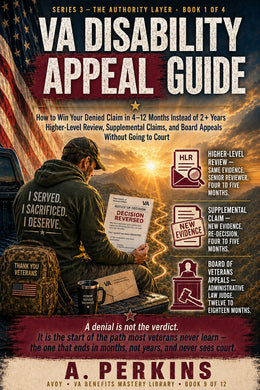
The VA Disability Appeal Guide: Win Your Denied Claim Without Going to Court The full playbook this article is built on — how to decode your decision letter, pick the right review lane, build a nexus that holds, and win in 4–12 months instead of waiting years. |
Frequently Asked Questions
How long do I have to appeal a VA denial?
One year from the date printed on your decision letter. Within that year you can file a Supplemental Claim (VA Form 20-0995), a Higher-Level Review (VA Form 20-0996), or a Board Appeal (VA Form 10182). If you miss the year, the decision becomes final — you can still file a Supplemental Claim later, but you lose the protected effective date and the back pay that comes with it.
What is the most common reason VA claims get denied?
A missing medical nexus. The VA agrees you have the condition and agrees you served — but nothing in the file medically links the two. The fix is a nexus letter or independent medical opinion stating it is "at least as likely as not" that the condition is related to service, with a written rationale.
Should I file a Higher-Level Review or a Supplemental Claim?
If evidence was missing, file a Supplemental Claim and add it. If the evidence was already in the file and the rater made a mistake — misread it, ignored it, or used the wrong diagnostic code — file a Higher-Level Review and request the informal conference. Higher-Level Review does not allow new evidence.
Will I lose my back pay if I appeal?
No. As long as you file within one year of the decision, your effective date is protected and back pay runs from your original claim date. That is the single biggest reason not to let the year lapse.
Do I need a lawyer to appeal a VA denial?
No. Filing is free, and a VA-accredited Veterans Service Officer (VSO) can help you at no cost. Attorneys and agents typically charge a percentage of your back pay. Many veterans win a denied claim themselves once they understand which leg of the claim broke and rebuild that piece.
Educational information only. AVOY is not a law firm and does not provide legal, medical, or financial advice, and does not represent veterans in claims. AVOY is not affiliated with, endorsed by, or sponsored by the U.S. Department of Veterans Affairs. Filing a VA claim is free, and a VA-accredited Veterans Service Officer (VSO) can assist you at no cost. Rules, forms, and processing times change — always confirm current information at VA.gov. In crisis? Dial 988, then press 1.