How to Appeal a VA Denial Letter: A Veteran's Step-by-Step Guide
Quick Answer: To appeal a VA denial letter, you choose one of three decision review lanes within one year of the decision date: a Supplemental Claim (new evidence), a Higher-Level Review (a second look), or a Board Appeal (a Veterans Law Judge). Read the letter, find why you were denied, then pick the lane that fixes that reason.
Featured Book

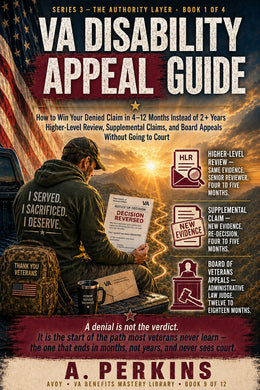
The VA Disability Appeal Guide — part of the avoy VA Benefits Mastery Library by A. Perkins. Get the book →
Why Veterans Ask This Question
You opened the envelope. The VA said no. Your stomach dropped, and now you are staring at a denial letter that feels like a locked door. This is one of the most common moments a veteran faces, and it is the reason so many people search for how to appeal a VA denial letter. You are not alone, and a denial is not the end of the road.
A denial letter is not the VA saying you have no case. Many times it is the VA saying you did not fully prove one piece of the case. The good news is that the claims system was built to give you more than one chance. When you understand the appeal lanes, a denial turns from a wall into a fork in the road.
Veterans ask about this for real reasons. Some were denied on their very first claim. Some got a low rating and want more. Some had a claim from years ago that never got fixed. Whatever brought you here, the steps to move forward are the same, and they start with reading the letter closely.
Understanding The Topic
When the VA decides your claim, it sends a decision letter. Inside that letter is the reason for the denial. That reason is the map. Once you know why the VA said no, you can choose the right way to answer. Today the VA offers three ways to ask for a review of a decision. This system is often called the modern appeals process.
The first lane is the Supplemental Claim. You use this when you have new and relevant evidence the VA did not have before. VA.gov confirms this uses VA Form 20-0995. New evidence means information the VA has not seen. Relevant evidence means information that proves or disproves something in your claim. A new doctor's report is a good example.
The second lane is the Higher-Level Review. You use this when you believe the VA made a mistake with the evidence it already had. A more senior reviewer takes a fresh look. VA.gov confirms this uses VA Form 20-0996. Important point from VA.gov: you cannot add new evidence in this lane. You are asking someone with more experience to catch an error.
The third lane is the Board Appeal. Here a Veterans Law Judge reviews your case. VA.gov confirms this uses VA Form 10182, called a Notice of Disagreement. The Board has three options: direct review with no new evidence, evidence submission where you add evidence within ninety days, and a hearing where you speak with the judge. Each option has a different wait time.
One deadline ties all of this together. VA.gov states you generally have one year from the date on your decision to file. Always confirm the current forms and deadlines on VA.gov before you file, because the VA can update them. Missing the window can cost you your effective date, which is the date that controls back pay.
What The VA Generally Looks For
Across every lane, the VA is looking for the same three things that make a claim strong. Understanding them helps you pick the right lane and fix the real problem instead of guessing.
First, the VA looks for a current diagnosis. You need a medical record that says you have the condition now. Without a diagnosis, there is nothing to rate. If your denial letter says there was no current disability, that is a clue you may need new medical evidence and a Supplemental Claim.
Second, the VA looks for an in-service event, injury, or exposure. This is proof that something happened during your service. It can be a treatment record, an incident report, or a buddy statement from someone who was there. If your letter says there was no event in service, you may need to dig up records or statements.
Third, the VA looks for a link, often called a nexus, that connects your current condition to your service. This link usually comes from a medical opinion. A denial that says the evidence does not connect your condition to service is often a nexus problem, and a strong medical opinion in a Supplemental Claim can answer it.
When you match the reason in your denial letter to one of these three building blocks, the right lane usually becomes clear. A missing piece of evidence points to a Supplemental Claim. A reviewer who ignored evidence you already sent points to a Higher-Level Review. A complex legal disagreement often points to the Board.
Common Mistakes Veterans Make
The biggest mistake is doing nothing. A denial letter feels final, so some veterans put it in a drawer and let the one-year window pass. The clock does not stop because the letter is painful. If you do nothing, the decision becomes final and you may have to start over later.
The second mistake is picking the wrong lane. Some veterans file a Higher-Level Review and then try to send new evidence, not knowing that lane does not accept it. Others file a Supplemental Claim with no new evidence at all. Reading the letter first, then matching the lane to the problem, avoids this trap.
A third mistake is sending the same evidence again. If the VA already saw your records and said no, sending those exact records in a new claim rarely changes the result. New and relevant means new. A fresh medical opinion or a document the VA never had is what moves the needle.
A fourth mistake is skipping the reason for denial. Veterans sometimes argue about their symptoms when the letter actually denied them for a missing service connection. If you answer the wrong question, even strong evidence can miss the point. The letter tells you exactly what to fix, so let it guide you.
A fifth mistake is going it alone when help is free. Accredited Veterans Service Officers help veterans file appeals at no cost. Trying to guess your way through complex rules, when free trained help exists, makes a hard process harder than it needs to be.
A Practical Educational Example
Consider a veteran we will call Marcus. This is an educational example, not a real case. Marcus filed a claim for a knee condition and got a denial letter. The letter said there was no medical link connecting his current knee pain to his service, even though he hurt his knee during a training exercise years ago.
Marcus almost gave up. Then he read the letter slowly and found the exact reason: a missing nexus. He already had a current diagnosis from his doctor, and he had a record of the training injury. The only gap was the link between the two. That single reason pointed him toward the right lane.
Because he needed to add something the VA had never seen, Marcus chose a Supplemental Claim. He asked his doctor to write a clear medical opinion explaining how the old training injury could have led to his current knee condition. That opinion was the new and relevant evidence the lane requires.
Marcus filed within his one-year window, kept a copy of everything, and worked with a free Veterans Service Officer to make sure the form was complete. He did not focus on his pain level or his rating. He focused on the one reason the VA gave, and he answered that reason directly. That focus is what made his appeal organized and clear.
The avoy Perspective
At avoy, we teach veterans to treat a denial letter as a set of instructions, not a rejection. The letter tells you the missing piece. Your job is to find that piece and hand it back in the right lane. This is the heart of The VA Disability Appeal Guide, part of the avoy VA Benefits Mastery Library by A. Perkins.
One avoy method we lean on is the Denial Decode. It is simple: read your decision letter, underline the exact reason for the denial, match that reason to one of the three building blocks of current diagnosis, in-service event, or nexus, and only then choose your lane. Decode first, then act. This keeps you from filing the wrong form or repeating evidence the VA already rejected.
The avoy approach is education, not shortcuts. We do not promise outcomes, because no honest source can. What we can do is help you understand the system so your next step is a smart one. When you know why you were denied and which lane fixes it, you stop reacting and start planning.
Frequently Asked Questions
How long do I have to appeal a VA denial letter?
VA.gov states you generally have one year from the date on your decision letter to request a review in one of the three lanes. Because deadlines can change and some claims have shorter windows, confirm your exact deadline on VA.gov and do not wait until the last week to file.
What are the three ways to appeal a VA decision?
They are the Supplemental Claim, the Higher-Level Review, and the Board Appeal. VA.gov lists the forms as VA Form 20-0995 for a Supplemental Claim, VA Form 20-0996 for a Higher-Level Review, and VA Form 10182 for a Board Appeal. Each lane fits a different kind of problem.
Which appeal lane should I choose?
It depends on why you were denied. If you have new evidence, a Supplemental Claim often fits. If you think the VA made an error with evidence it already had, a Higher-Level Review may fit. If your case is complex or legal, the Board may be the right path. Read your letter first.
Can I add new evidence to a Higher-Level Review?
No. VA.gov confirms that the Higher-Level Review does not accept new evidence. In that lane, a more senior reviewer looks again at the evidence already in your file. If you have something new to add, the Supplemental Claim is usually the better lane for that evidence.
What is new and relevant evidence?
VA.gov defines new evidence as information the VA has not considered before, and relevant evidence as information that proves or disproves something in your claim. A fresh medical opinion or a buddy statement the VA never saw can qualify. Sending the same records again usually does not count.
Do I need a lawyer to appeal a VA denial?
You do not have to hire anyone. Accredited Veterans Service Officers help veterans file appeals for free. Some veterans also choose an accredited claims agent or attorney for complex cases. avoy is educational and not a substitute for accredited help, so consider a free VSO as your first stop.
Will appealing lower my current rating?
This is a common fear. The rules are detailed and depend on your situation, so avoy does not make promises about outcomes. This is a good question to bring to an accredited VSO or to research on VA.gov, so you understand the specific rules that apply to your case before you file.
Key Takeaways
- A VA denial letter is a set of instructions, not the end. The reason for the denial is your map.
- There are three lanes: Supplemental Claim (VA Form 20-0995), Higher-Level Review (VA Form 20-0996), and Board Appeal (VA Form 10182), confirmed on VA.gov.
- You generally have one year from the decision date to file, per VA.gov. Confirm your exact deadline before filing.
- Match the reason for denial to a current diagnosis, an in-service event, or a nexus, then pick the lane that fixes it.
- Avoid the top mistakes: doing nothing, picking the wrong lane, or resending old evidence.
- Free accredited Veterans Service Officers can help you file at no cost.
Related Resources
- VA Claim Denied: What To Do Next
- What Is a Nexus Letter?
- VA Secondary Conditions Explained
- The VA Disability Appeal Guide — avoy VA Benefits Mastery Library
- Free VA Appeals Checklist
- Ask the avoy Veteran Navigator AI
This guide reflects the educational work of A. Perkins — a former Air Force nuclear missile launch officer and a disabled veteran, author of the avoy VA Benefits Mastery Library and builder of the avoy Veteran Navigator AI.
Call To Action
Want a personalized educational roadmap? The avoy Veteran Navigator AI helps veterans better understand VA disability claims, ratings, secondary conditions, appeals, caregiver benefits, and family benefits — free educational guidance built on the avoy framework. Start free at avoyvet.com.
Educational information only. AVOY is not a law firm and does not provide legal, medical, or financial advice, and does not represent veterans in claims. AVOY is not affiliated with, endorsed by, or sponsored by the U.S. Department of Veterans Affairs. Filing a VA claim is free, and a VA-accredited Veterans Service Officer (VSO) can assist you at no cost. In crisis? Dial 988, then press 1.