VA Claim Denied? What to Do Next: A Veteran's Step-by-Step Guide
Quick Answer: If your VA claim was denied, you have not lost. Read the decision letter, find the exact reason, and choose a review path: a Supplemental Claim with new evidence, a Higher-Level Review, or a Board appeal. You generally have one year from the decision date. This is education, not legal advice.
Featured Book

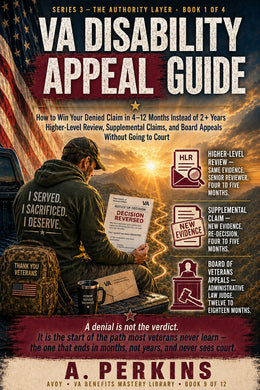
The VA Disability Appeal Guide — part of the avoy VA Benefits Mastery Library by A. Perkins. Get the book →
Why Veterans Ask This Question
Opening a VA decision letter and reading the word denied is a gut punch. You did the work. You filed the claim. You waited months. And now it feels like the door slammed shut. So you sit there asking the only question that matters: my VA claim was denied, what do I do next?
Here is the first thing to know. A denial is not the end of the road. It is a step in the road. The VA has a built-in review and appeals system, and a large number of claims that are first denied are later granted once the right evidence or the right argument shows up. A denial usually means one specific thing was missing, not that your case is hopeless.
Veterans ask this question because the letter itself is confusing, the clock is ticking, and the wrong move can cost time or money. This guide breaks the process down in plain language: how to read the denial, the review paths you can choose from, the mistakes that make things worse, and a practical example of how a veteran might respond. It is educational information to help you understand your options. It is not legal advice, and it does not promise any outcome.
Understanding The Topic
When the VA denies a claim, it sends a decision letter. That letter is the most important document you own right now, because it tells you exactly why you were denied. The reason usually falls into one of a few buckets: the VA did not find a current diagnosis, it did not find a link between your condition and your service, it decided the evidence did not meet the rating criteria, or a deadline or form issue got in the way.
Under the modern VA review system, a denial does not force you into one giant appeal. Instead, you generally choose one of three lanes. The first is a Supplemental Claim, where you add new and relevant evidence the VA did not have before. The second is a Higher-Level Review, where a more senior reviewer looks at the same evidence for an error, with no new evidence added. The third is a Board Appeal, where a Veterans Law Judge at the Board of Veterans' Appeals reviews your case.
Each lane has its own use, and picking the right one depends on why you were denied. If you were denied because evidence was missing, adding that evidence through a Supplemental Claim often makes sense. If you believe the VA made a mistake with the evidence it already had, a Higher-Level Review may fit. If your issue is complex or you want a judge to decide, the Board path exists. The rules, timelines, and forms for each are set by the VA and can change, so confirm the current details on VA.gov before you file.
What The VA Generally Looks For
To respond well to a denial, you have to answer the VA on its own terms. That means going back to the basic building blocks of any service-connection claim: a current diagnosed condition, an in-service event, injury, or illness, and a medical link, often called a nexus, that connects the two.
Read your denial letter and match the reason to the missing building block. If the letter says there was no current diagnosis, you likely need current medical records or an exam that names the condition. If it says there was no link to service, you likely need a nexus opinion or evidence of the in-service event. If it says the condition did not meet the rating criteria, you may need evidence that better shows how severe your symptoms really are.
The VA also cares about deadlines. In general, you have one year from the date on your decision to keep the claim moving in a way that protects your original effective date. Miss that window, and you may be able to file again, but you could lose back pay tied to the earlier date. Because deadlines and the exact time limits can change, confirm the current window that applies to your decision on VA.gov. This guide does not quote a specific dollar amount or a changed rule on purpose, because the safest number is the one you verify on the official source.
Common Mistakes Veterans Make
A denial is recoverable, but some reactions make it harder. Here are the ones that trip veterans up most.
Doing nothing until the deadline passes. This is the most costly mistake. The clock protects your effective date, and letting it run out can cost back pay. Act while your window is open.
Not reading the actual reason for the denial. Many veterans refile the same claim with the same evidence and get the same result. The decision letter tells you what was missing. Fix that specific gap.
Choosing the wrong review lane. Filing a Higher-Level Review when your real problem is missing evidence can waste months, because that lane does not accept new evidence. Match the lane to the reason.
Adding evidence that is not new or relevant. In a Supplemental Claim, evidence generally needs to be new and relevant. Resubmitting the same records the VA already reviewed usually does not move the needle.
Skipping the nexus when the denial was about the link. If you were denied because the VA found no connection to service, a well-reasoned medical opinion is often the piece that changes the result.
Going silent at the C&P exam or missing it. If a new exam is scheduled, attend it and describe your symptoms honestly and fully. Minimizing how you function can hurt your case.
A Practical Educational Example
Consider a veteran we will call M. This example is made up to show the process, not a real person. M filed a claim for a knee condition and received a denial. The letter said the VA acknowledged an in-service injury but found no current medical evidence showing an ongoing, diagnosed knee condition.
Instead of refiling blindly, M read the letter closely and saw the exact gap: there was an in-service event, but no recent diagnosis in the file. M scheduled an appointment, got current imaging and a clear diagnosis, and gathered the treatment records that showed the condition was ongoing.
Because the problem was missing evidence rather than a review error, M chose the Supplemental Claim lane and submitted the new and relevant medical records, along with a short personal statement describing how the knee affected daily life and work. M filed within the one-year window to protect the original effective date and attended the follow-up exam honestly. This example does not promise M a specific result, because no one can. It simply shows how matching the response to the reason for denial tends to produce a complete, well-organized next step.
The avoy Perspective
At avoy, the approach to a denial is calm and systematic. The The VA Disability Appeal Guide, part of the avoy VA Benefits Mastery Library, is built on one core idea: a denial is a set of instructions in disguise. The letter tells you what the VA felt was missing, and your job is to answer that exact point in the correct lane.
The avoy read, diagnose, route method walks you through it. First, read the decision letter carefully and underline the stated reason. Second, diagnose which building block is missing: diagnosis, in-service event, or nexus. Third, route your response to the lane that fits, whether that is a Supplemental Claim with new evidence, a Higher-Level Review for an error, or a Board appeal. The goal is never to fight blindly. The goal is to respond precisely, protect your deadline, and give the VA what it actually needs to decide in your favor. That is the heart of the avoy educational method: understand the rules, gather the right evidence, and present it clearly.
Frequently Asked Questions
Does a denial mean my claim is over?
No. A denial is a decision you can respond to through the VA review and appeals system. Many claims that are first denied are later granted once the missing piece is added or an error is corrected. Confirm current options on VA.gov.
How long do I have to respond to a VA denial?
In general, you have one year from the date on the decision to keep the claim moving in a way that protects your original effective date. Because time limits can change, confirm the exact deadline that applies to your decision on VA.gov.
What is the difference between a Supplemental Claim and a Higher-Level Review?
A Supplemental Claim is for adding new and relevant evidence the VA did not have. A Higher-Level Review asks a more senior reviewer to look at the same evidence for an error, with no new evidence added. The right one depends on why you were denied.
Should I just refile the same claim?
Usually not. Refiling the same claim with the same evidence often leads to the same denial. Read the decision letter, find the exact reason, and address that specific gap instead.
Do I need new evidence to appeal?
It depends on the lane. A Supplemental Claim generally requires new and relevant evidence. A Higher-Level Review does not add new evidence and instead looks for an error in the existing record.
What if the denial says there is no link to my service?
That points to a missing nexus. A well-reasoned medical opinion connecting your current condition to your service, often using the at least as likely as not standard, is frequently the piece that changes the result.
Can I get help with my appeal?
Yes. A VA-accredited Veterans Service Officer, an accredited claims agent, or an accredited attorney can help you understand and file your appeal. Many VSOs assist at no cost.
Key Takeaways
- A VA denial is a step in the process, not the end of your claim.
- The decision letter tells you the exact reason you were denied; read it first.
- You generally choose one of three lanes: Supplemental Claim, Higher-Level Review, or Board appeal.
- Match the lane to the reason: missing evidence points to a Supplemental Claim, a suspected error to a Higher-Level Review.
- You usually have one year to protect your original effective date; confirm the exact deadline on VA.gov.
- A VA-accredited VSO, claims agent, or attorney can help you respond.
Related Resources
- How to Appeal a VA Denial Letter
- What Is a Nexus Letter?
- VA Secondary Conditions Explained
- The VA Disability Appeal Guide (book)
- Free VA Appeals Checklist
- Ask the avoy Veteran Navigator AI
This guide reflects the educational work of A. Perkins — a former Air Force nuclear missile launch officer and a disabled veteran, author of the avoy VA Benefits Mastery Library and builder of the avoy Veteran Navigator AI.
Call To Action
Want a personalized educational roadmap? The avoy Veteran Navigator AI helps veterans better understand VA disability claims, ratings, secondary conditions, appeals, caregiver benefits, and family benefits — free educational guidance built on the avoy framework. Start free at avoyvet.com.
Educational information only. AVOY is not a law firm and does not provide legal, medical, or financial advice, and does not represent veterans in claims. AVOY is not affiliated with, endorsed by, or sponsored by the U.S. Department of Veterans Affairs. Filing a VA claim is free, and a VA-accredited Veterans Service Officer (VSO) can assist you at no cost. In crisis? Dial 988, then press 1.