PTSD VA Rating: How the VA Rates PTSD From 0 to 100%
Quick Answer: The VA rates PTSD from 0 to 100% under the General Rating Formula for Mental Disorders (38 CFR 4.130). Your level is set by how much your symptoms limit work and social functioning, not by the diagnosis label. The same PTSD diagnosis can rate anywhere on that ladder depending on what your records and exam show.
Featured Book

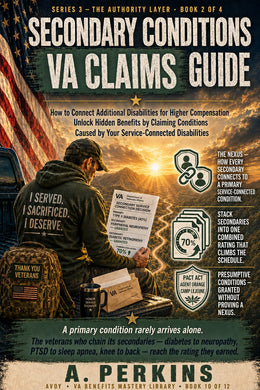
PTSD & Mental Health VA Disability Claims Guide — part of the avoy VA Benefits Mastery Library by A. Perkins. Get the book →
Why Veterans Ask About Their PTSD VA Rating
If you are searching for your PTSD VA rating, you probably already have the diagnosis and now you want to know one thing: what number will the VA put on it, and why. It is one of the most searched veteran questions because the answer feels like a black box. Two veterans with the same diagnosis can walk out with a 30% and a 70%, and neither one is told plainly how that happened.
The confusion is real, but the system underneath is not random. Once you understand the one formula the VA uses for every mental-health condition, your rating stops looking like luck and starts looking like something you can document. This guide explains that formula in plain words, shows what examiners actually look for, and points out the mistakes that quietly hold veterans at a lower number than their records support.
Understanding How PTSD Is Rated
Here is the part almost nobody explains clearly: the VA does not have a separate rating chart for PTSD. It rates PTSD the same way it rates depression, anxiety, and every other mental-health condition — on a single scale called the General Rating Formula for Mental Disorders, found in the regulation 38 CFR 4.130.
That scale has six levels: 0%, 10%, 30%, 50%, 70%, and 100%. Each level describes a degree of 'occupational and social impairment' — plain words, that means how much your symptoms get in the way of holding a job and keeping relationships. The VA reads your evidence, decides which description fits you best, and assigns that percentage.
The key idea to hold onto: the label does not set the number — the impact does. The word 'PTSD' tells the VA what you have. The rating tells the VA how much it costs you day to day. That is why the same diagnosis can land at 30% for one veteran and 70% for another. The one who documented how the symptoms actually affect work, sleep, focus, and relationships gave the VA a reason to rate higher.
What the VA Generally Looks For
Under 38 CFR 4.130, each rating level ties to a picture of how you function. In simple terms, the ladder looks like this:
- 0%: A diagnosed condition, but symptoms are not severe enough to interfere with work or social life or to need continuous medication.
- 10%: Mild symptoms that cause a small dip in work or social function, or symptoms controlled by medication.
- 30%: Occasional dips in work efficiency, with symptoms like anxiety, mild memory loss, sleep trouble, or a depressed mood — generally still functioning.
- 50%: Reduced reliability and productivity — trouble with concentration, panic more than once a week, difficulty understanding complex tasks, and strained relationships.
- 70%: Deficiencies in most areas — work, school, family, judgment, mood — with symptoms like near-continuous panic or depression, trouble adapting to stress, and difficulty maintaining relationships.
- 100%: Total occupational and social impairment — symptoms so severe that holding any job and maintaining relationships is not possible.
The examiner at your Compensation and Pension (C&P) exam records how your symptoms match this ladder, usually on a form called a Disability Benefits Questionnaire (DBQ). A separate claims processor then reads that exam plus your other evidence and assigns the rating. So the exam matters enormously — but it is not the only voice. Your own statement and buddy statements can fill gaps the exam misses.
It also helps to understand what each jump is worth. Because the ladder moves in big steps — 30 to 50 to 70 — landing one level higher can change your monthly compensation meaningfully, and at the top it can open the door to being considered totally disabled. That is why documenting to the correct level matters so much: the difference between a 50% and a 70% is not a rounding error, it is a different life for a lot of veterans. The exact dollar amounts change every December with the cost-of-living adjustment, so always confirm the current figures on VA.gov rather than relying on an old number you saw somewhere.
One more thing that trips people up: a mental-health rating is not permanent by default. If your symptoms improve, a future re-exam can lower it; if they worsen, you can file for an increase. The rating is a snapshot of documented function at a point in time, which is exactly why the words you use — and the statements you gather — carry so much weight.
Common Mistakes Veterans Make
Most veterans who are rated too low for PTSD did not have a weak case — they had a weakly documented one. The pattern repeats:
- Describing a good day at the exam. Veterans instinctively downplay. When the examiner asks how you are doing, 'I'm okay' becomes a 30%. The exam captures the day you show up, so it must reflect your worst days honestly, not just the morning you managed to get there.
- Talking about the diagnosis, not the impact. Saying 'I have PTSD' proves the label. Describing that you have not slept a full night in months, that you left your last job after a panic episode, and that you avoid family gatherings — that is what maps to the rating levels.
- Filing the wrong mental-health theory. Labeling a condition that is really depression or anxiety as 'PTSD' can sink an otherwise winnable claim if there is no qualifying in-service stressor. The condition has to match the correct track.
- Leaving secondary conditions on the table. PTSD commonly links to other conditions the VA can also compensate. More on that below — it is one of the biggest missed levers.
- Letting a bad exam stand. If the C&P exam undersells your reality, lay evidence and buddy statements can rebut it, and an inadequate exam can even be grounds to challenge a low rating.
A Practical Educational Example
Consider a veteran — we will call him a composite, not a real person — rated at 30% for PTSD after his first claim. On paper, 30% looked 'fine.' But when he sat down and wrote out his actual week, a different picture emerged: he was waking three or four times a night, had been written up twice at work for missing deadlines he used to hit easily, had stopped attending his kids' events because crowds triggered panic, and had snapped at his spouse so often they were barely speaking.
None of that was in his file. His original exam captured a man who said he was 'managing.' When he gathered a statement from his spouse describing the sleep and the withdrawal, a statement from a coworker about the performance change, and wrote his own account in the language of function — frequency, severity, impact — the documentation now matched the 70% description of 'deficiencies in most areas.' This is educational example only; every claim rises or falls on its own evidence and its own exam. But it shows the mechanism: the diagnosis never changed. The documented impact did.
The avoy Perspective
The avoy VA Benefits Mastery Library book PTSD and Mental Health VA Claims teaches one core discipline for mental-health ratings: describe your function in the language of the 4.130 formula. Not 'I have bad days' — but how often, how severe, and what it stops you from doing. The avoy method is to write and speak about your worst realistic days in terms of work reliability, concentration, panic frequency, and relationships, because those are the exact words the rating ladder is built from.
avoy also stresses matching the condition to the correct track before you file — PTSD needs an in-service stressor, while depression or anxiety may be direct or secondary to a physical condition — and using lay and buddy statements as a backstop for when the exam undersells your reality. And avoy points to the biggest quiet lever most veterans miss: secondary conditions. PTSD is frequently linked to sleep apnea, migraines, hypertension, and GERD. Each one, properly documented and connected, can raise your combined rating. That is the heart of what avoy calls the avoy Way — climbing from 30 toward 100 by stacking well-documented secondary conditions rather than pinning everything on one number.
Frequently Asked Questions
How does the VA decide my PTSD rating?
The VA uses the General Rating Formula for Mental Disorders (38 CFR 4.130) and picks the level — 0, 10, 30, 50, 70, or 100% — that best matches how much your symptoms limit work and social functioning, based on your exam and evidence.
Can the same PTSD diagnosis get different ratings?
Yes. The rating reflects documented impairment, not the diagnosis label. Two veterans with the same diagnosis can rate very differently depending on what their records and C&P exam show about daily function.
What is the PTSD C&P exam?
It is an evaluation, often using a DBQ, where an examiner records how your condition affects work and social life. It is not a treatment visit. Describe your worst realistic days honestly, because a separate processor rates from what the exam captures.
Does a higher PTSD rating happen automatically over time?
No. If your symptoms have worsened, you generally have to file for an increase and document the current severity. Nothing rises on its own.
Can I get a rating for conditions caused by my PTSD?
Often yes. Conditions medically linked to service-connected PTSD — such as sleep apnea or migraines — may be claimed as secondary conditions, each with its own diagnosis and nexus. This is one of the most under-used ways to raise a combined rating.
What if my exam does not reflect how bad it really is?
Lay statements from you and buddy statements from people who see you day to day can rebut an exam that undersells your reality, and an inadequate exam can sometimes be challenged directly.
Key Takeaways
- The VA rates PTSD 0–100% on one formula (38 CFR 4.130) built around how symptoms limit work and social function.
- The diagnosis sets the label; the documented impact sets the number.
- Describe your worst realistic days in terms of frequency, severity, and function — that is the language of the rating ladder.
- Match the condition to the right mental-health track before filing.
- Secondary conditions linked to PTSD are a major, often-missed way to raise a combined rating.
- Confirm current compensation amounts on VA.gov — rates change every December.
Related Resources
- Can migraines be secondary to PTSD?
- Can sleep apnea be secondary to PTSD?
- VA secondary conditions explained
- Book: PTSD and Mental Health VA Claims
- Free guide: The avoy VA Evidence Checklist
- Ask the avoy Veteran Navigator AI™ about your situation.
Call To Action
Want a personalized educational roadmap? The avoy Veteran Navigator AI™ helps veterans better understand VA disability claims, ratings, secondary conditions, appeals, caregiver benefits, and family benefits — free educational guidance built on the avoy framework. Start free at avoyvet.com.
Educational information only. AVOY is not a law firm and does not provide legal, medical, or financial advice, and does not represent veterans in claims. AVOY is not affiliated with, endorsed by, or sponsored by the U.S. Department of Veterans Affairs. Filing a VA claim is free, and a VA-accredited Veterans Service Officer (VSO) can assist you at no cost. In crisis? Dial 988, then press 1.
This guide reflects the educational work of A. Perkins — a former Air Force nuclear missile launch officer and a disabled veteran, author of the avoy VA Benefits Mastery Library and builder of the avoy Veteran Navigator AI™.