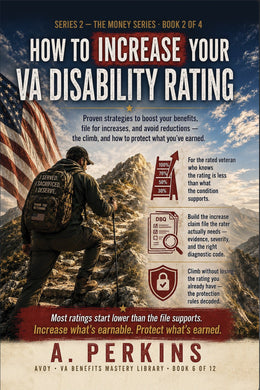
Disabled veterans carry an average of 7.34 service-connected disabilities, according to VA's 2026 Annual Benefits Report — and conditions rarely stay frozen at the percentage assigned years ago. Backs stiffen. Knees give out. Mental health symptoms tighten their grip. Yet thousands of veterans keep collecting compensation at a rating that stopped matching reality a long time ago, assuming the decision letter was permanent. It was not. A VA rating increase is available any time a service-connected condition worsens, and there is no cap on how many times a veteran may ask. This guide lays out who qualifies, what evidence carries weight in 2026, how to file, and what happens after the claim is submitted.
Key Takeaways
- Recognize that an increase is a claim about current severity, not an appeal.
- Document worsening with recent records, medication changes, and lay statements.
- Compare symptoms against the criteria for the diagnostic code already assigned.
- File VA Form 21-526EZ, choosing between a Standard and Fully Developed Claim.
- Protect back pay under the effective-date rule at 38 CFR 3.400(o)(2).
- Prepare for a C&P exam and know the rating protections at 38 CFR 3.344.
Table of Contents
- Who Qualifies for a VA Rating Increase
- Building the Evidence That Proves a Condition Worsened
- Filing Strategy: Standard Claim vs. Fully Developed Claim
- Step-by-Step: Submitting the Increase Claim
- After Filing: C&P Exam, Decision, and Next Moves
- Frequently Asked Questions
 |
From the AVOY VA Benefits Mastery Library How to Increase Your VA Disability Rating — Series 2 Bk 2 covers this in full depth, with step-by-step guidance for exactly this situation. Get the Book → |
Who Qualifies for a VA Rating Increase
The frustration is familiar: a veteran was rated at 30 percent for a back condition in 2019, has since lost range of motion and now misses work regularly, but assumes nothing can be done because the claim was already "decided." That assumption costs money every month. Eligibility for an increase is far simpler than most veterans expect.
Two conditions must be met. First, the disability must already be service-connected — VA has agreed the condition is tied to service, so that argument is settled. Second, the condition must be measurably worse now than when the current rating was assigned. That is the entire test. There is no waiting period, no limit on how many increase claims a veteran may file, and no requirement to have appealed the original decision.
Speed favors veterans who act in 2026. VA reported an average of 78.6 days to complete a disability claim as of the end of May 2026, down sharply from 141.5 days in January 2025. A claim filed today is being decided in a system moving faster than it has in years.
When an Increase Is the Wrong Tool
An increase claim is not the right path in every situation. If VA denied service connection outright, or if a recent rating decision contained a clear error, the decision-review lanes apply instead — a Higher-Level Review for errors on the existing evidence, or a Supplemental Claim when new and relevant evidence exists. Veterans have one year from the date on a decision letter to request a Higher-Level Review or a Board Appeal. An increase claim, by contrast, says nothing about whether the old decision was right. It says only that the condition today is worse than the condition VA last examined. Reading the decision letter carefully before filing prevents months of wasted time in the wrong lane.
Building the Evidence That Proves a Condition Worsened
Most increase claims fail for one reason: the file shows a veteran saying the condition is worse, with nothing in the record showing how much worse. VA raters work from documents, not impressions. The backlog fell below 100,000 claims in February 2026 for the first time since 2020, which means files are being reviewed more promptly — and a thin file gets a prompt denial just as easily as a prompt grant.
Evidence for an increase should answer a single question: what has changed since the last rating decision? Recent treatment records are the backbone. Medication increases, specialist referrals, imaging showing progression, and therapy notes documenting reduced function all carry weight because clinicians created them in the ordinary course of treatment.
Records, Test Results, and Private Evidence
VA treatment records are pulled automatically, but private records are not. A veteran treating with a civilian physician, a private therapist, or a specialist outside the VA system must submit those records or authorize VA to request them. Private Disability Benefits Questionnaires completed by a treating provider can also translate clinical findings into the exact language of the rating criteria. Test results matter too — pulmonary function tests, sleep studies, range-of-motion measurements, and lab work create objective anchors a rater cannot ignore.
Lay Statements and Symptom Logs
Where medical records fall short, lay evidence fills the gap. A spouse who describes nightly interruptions, a coworker who documents missed shifts, an adult child who has taken over household tasks — each statement supplies detail no clinic note captures. Veterans should also keep a symptom log covering flare-ups, frequency, duration, and what daily activities become impossible during them. Under the AVOY educational framework, one page per condition, written plainly and dated, is more persuasive than a lengthy narrative covering everything at once.
Filing Strategy: Standard Claim vs. Fully Developed Claim
Veterans face a decision point on the application itself, and many check a box without understanding what it does. The 2026 compensation figures make the stakes concrete: VA confirmed a 2.8 percent cost-of-living adjustment effective December 1, 2025, so every month spent at an outdated rating is a month of compensation that reflects a condition the veteran no longer has.
A Standard Claim puts the duty to assist squarely on VA. The agency gathers federal records, requests private records under authorization, and develops the file. It is slower, but it is the safer route when records are scattered across multiple providers or when a veteran is unsure what exists.
A Fully Developed Claim is a commitment: the veteran certifies that all available evidence has been submitted with the application, and VA processes it on a faster track. Nothing is lost by choosing it if the file is genuinely complete — VA still schedules an examination and still obtains federal records. The risk is filing under the FDC program with gaps, which pushes the claim back into the standard lane and burns the time advantage that made the choice attractive in the first place.
Choosing the Right Lane for an Increase
For increase claims specifically, the Fully Developed route often fits well. The service-connection question is already settled, so the evidence needed is narrow: current records showing current severity. A veteran who has gathered the last twelve months of treatment notes, a completed DBQ, and two lay statements is usually holding everything the rater needs. When private records are still outstanding or a provider has not responded, the Standard Claim protects the veteran by putting VA's development duty to work. The correct choice depends on the state of the file on the day of filing, not on which option sounds faster.
Step-by-Step: Submitting the Increase Claim
Knowing the rules and executing them are different problems. Compensation at stake in 2026 for a veteran with no dependents is $552.47 monthly at 30 percent, $1,132.90 at 50 percent, $1,435.02 at 70 percent, and $3,938.58 at 100 percent. Moving between tiers changes a household budget permanently, so the submission sequence deserves care.
- File an Intent to File. VA Form 21-0966 locks in a potential effective date and opens a one-year window to complete the claim.
- Pull the current rating decision. Identify the diagnostic code already assigned and read the criteria for the next percentage tier, so evidence targets a specific threshold.
- Gather and organize evidence. Assemble treatment records, test results, DBQs, and lay statements from the period since the last decision, labeled by condition.
- Complete VA Form 21-526EZ. The same application used for original claims is used for increases; list the condition with a note that it has worsened and when.
- Submit and confirm. File online at VA.gov, by mail, in person at a regional office, or through an accredited representative, then verify the claim appears in the claim status tool.
Protecting the Effective Date
Back pay in increase claims turns on 38 CFR 3.400(o)(2). If evidence shows it was factually ascertainable that the condition worsened within the year before the claim was received, the effective date can reach back to that earlier point. A dated treatment note, an emergency-room visit, or a documented medication change becomes financially valuable, not merely medical. Veterans who wait years to file forfeit everything beyond that one-year window.
Getting Free Help With the Filing
Accredited Veterans Service Officers assist with claims at no cost, and many state and county veteran service offices provide the same help locally. Accredited claims agents and attorneys are also options. Free assistance is widely available, and using it costs a veteran nothing but the time to make the appointment.
After Filing: C&P Exam, Decision, and Next Moves
The waiting period is where most veterans feel powerless, and where preparation still matters. VA will almost always schedule a Compensation and Pension examination on an increase claim, because the agency needs a current picture of severity. Missing that appointment without rescheduling can result in a decision based solely on the existing record.
Preparing for the C&P Exam
The examiner sees the veteran for a limited window and writes findings that heavily influence the outcome. The educational principle that runs through the AVOY library applies here: describe the worst days, not the best. An examination scheduled on a good day, answered optimistically, produces a report that understates the disability. Veterans should describe flare-up frequency, what daily tasks become impossible, how symptoms affect employment, and how often the condition interferes with sleep. Bringing a written summary and a symptom log helps ensure nothing important is forgotten in a short appointment.
Reading the Decision and Understanding Protections
The rating decision explains which evidence was considered and which criteria were applied. If the increase is denied or granted at a lower tier than expected, a Supplemental Claim with new and relevant evidence or a Higher-Level Review remains available, with one year from the decision date to request a Higher-Level Review or Board Appeal. Filing for an increase does carry a real consideration: the examination could show improvement. Rating-protection rules at 38 CFR 3.344 apply here — a rating in effect five years or more is considered stabilized and cannot be reduced without evidence of sustained material improvement under the ordinary conditions of life, and a rating continuously in effect for 20 years is protected from reduction absent fraud. Understanding those protections before filing turns an anxious decision into an informed one, and it is the difference between guessing and knowing what is actually at stake.
Take the Next Step
A worsening condition deserves a rating that matches it. The free VA Claim Readiness Test at avoyvet.com walks veterans through what evidence is already in hand, what is missing, and what to gather before filing an increase claim. AVOY Veteran Navigator AI™ is also available at avoyvet.com to answer questions about ratings, evidence, appeals, and survivor benefits in plain language, any hour of the day. Preparation is the part of this process a veteran fully controls — and it is the part that most often decides the outcome.
Frequently Asked Questions
How many times can a veteran file for a VA rating increase?
There is no limit. A veteran may request an increase any time a service-connected condition worsens, whether once or several times across decades. Each filing is evaluated on current evidence of severity. The practical constraint is not the rules but the record: filing without new evidence of worsening usually results in the rating being continued. A useful benchmark is whether something has changed that a rater could see in writing — a new medication, a related complication, a surgery, a documented decline in function, or a change in work capacity.
Can filing for an increase cause a rating to be reduced?
It is possible, which is why preparation matters. If an examination shows genuine improvement, VA can propose a reduction. Protections exist, however. Under 38 CFR 3.344, a rating in effect for five years or more is treated as stabilized and cannot be reduced on a single better examination; VA must show sustained material improvement under the ordinary conditions of life. A rating continuously in effect for 20 years is protected from reduction except in cases of fraud. Veterans whose records clearly reflect worsening face little practical reduction risk.
What form is used to request a VA rating increase?
VA Form 21-526EZ, the Application for Disability Compensation and Related Compensation Benefits, is the same form used for original claims and for increases. The condition is listed along with an indication that it has worsened since the last decision. Filing VA Form 21-0966, the Intent to File, first is a common strategic step because it preserves a potential effective date while evidence is gathered. Submission is available online at VA.gov, by mail, in person at a regional office, or through an accredited representative. Confirm current form versions on VA.gov before filing.
How long does a rating increase claim take in 2026?
Processing times vary by condition, evidence, and regional office workload, so no timeline is guaranteed. As context, VA reported an average of 78.6 days to complete a disability claim as of the end of May 2026, compared with 141.5 days in January 2025, and the backlog of claims pending more than 125 days dropped below 100,000 in February 2026 for the first time since 2020. Claims needing extensive private-record development or added examinations take longer. The VA.gov claim status tool provides tracking.
Does an increase claim reset the effective date for back pay?
Back pay on an increase generally runs from the date the claim was received. The important exception is 38 CFR 3.400(o)(2): if evidence shows it was factually ascertainable that the disability increased within the one year before the claim was received, the effective date can be set at that earlier point. This is why dated medical evidence matters so much. A treatment note from eight months before filing that documents worsening can move the effective date backward and add months of retroactive compensation. Evidence older than that window generally cannot extend the effective date.
Is a nexus letter needed for an increase claim?
Usually not. A nexus letter connects a condition to military service, and service connection is already established for a condition being increased. What matters instead is current severity evidence — treatment records, examination findings, test results, and functional-impact statements measured against the rating criteria for that diagnostic code. A nexus letter does become relevant when claiming a secondary condition caused or aggravated by the already-rated disability, since that is a new service-connection question. Separating the two prevents veterans from paying for documentation an increase claim does not require.
Should a veteran file for secondary conditions at the same time?
Often yes, though they are legally different claims. An increase asks for a higher percentage on an existing condition; a secondary claim asks VA to service-connect a new condition caused or aggravated by that disability. Common examples include depression secondary to chronic pain, or a knee condition secondary to an altered gait. Both can be listed on the same VA Form 21-526EZ. Because VA combines ratings rather than adding them, a well-chosen secondary condition sometimes raises a combined rating more than an increase alone.
Educational information only — not legal, medical, or claim representation, and not affiliated with the U.S. Department of Veterans Affairs. For help filing or appealing, contact a VA-accredited VSO (often free), claims agent, or attorney. For current rates, forms, and deadlines, see VA.gov.