A 30 percent rating and a 50 percent rating are separated by $580.43 every month. As of the rates effective December 1, 2025, a Veteran alone at 30 percent receives $552.47 per month, while a Veteran alone at 50 percent receives $1,132.90. That gap comes to $6,965.16 over a year — and thousands of Veterans sit at 30 percent for years without knowing the criteria that separate the two. The frustration is rarely about effort. It is about evidence that never described the condition the way the rating schedule measures it. This guide breaks down what actually changes between 30 and 50 percent in 2026, and how to build the record that reflects it.
Key Takeaways
- Understand that the 30-to-50 percent jump is worth $580.43 per month for a Veteran alone under the rates effective December 1, 2025.
- Recognize that VA rates severity against specific diagnostic criteria, not against how long a condition has existed.
- Document frequency, duration, and functional loss — the three measures most rating criteria are built around.
- Apply 38 CFR 4.7, which directs VA to assign the higher of two evaluations when the disability picture more nearly approximates it.
- Claim dependents, which become payable at a combined 30 percent and increase again at every step above it.
- Weigh an increase claim against the risk of a reduction before filing, and know which protections apply.
Table of Contents
- What Separates a 30 Percent Rating From a 50 Percent Rating
- The Evidence That Moves a Rating Up
- Choosing Between an Increase Claim and a New Condition
- Filing the Increase, Step by Step
- After You File: Exams, Decisions, and Risk
 |
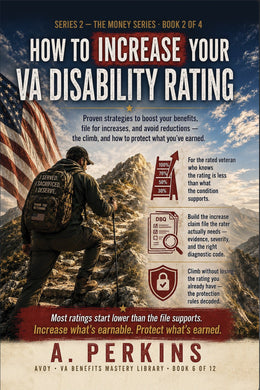
From the AVOY VA Benefits Mastery Library How to Increase Your VA Disability Rating — Series 2 Bk 2 covers this in full depth, with step-by-step guidance for exactly this situation. Get the Book → |
What Separates a 30 Percent Rating From a 50 Percent Rating
Many Veterans assume a higher rating follows naturally from a longer history with a condition. It does not. VA assigns a percentage by comparing documented severity against the criteria in the rating schedule for that specific diagnostic code. Two Veterans with the same diagnosis can hold different ratings because one record describes frequency and functional loss in the terms the schedule measures, and the other does not.
The financial difference is concrete. Under the rates effective December 1, 2025, a Veteran alone moves from $552.47 at 30 percent to $795.84 at 40 percent, and to $1,132.90 at 50 percent. Each step is a separate criteria threshold, not a gradual slope. A record that lands just short of the 50 percent language will be rated at 40 percent, even if the Veteran experiences the condition as severe.
Why the Criteria, Not the Diagnosis, Controls the Percentage
Most rating criteria are written around three measures: how often symptoms occur, how long they last, and what they prevent the Veteran from doing. A mental health condition is rated on occupational and social impairment. A musculoskeletal condition is rated largely on range of motion and painful motion. A respiratory condition is rated on pulmonary function testing values. In each case the diagnosis establishes service connection, while these measures set the percentage.
The productive question is therefore not whether a condition has worsened in general, but which specific criteria the current evidence does and does not satisfy.
The Evidence That Moves a Rating Up
VA decides increase claims on the evidence in the file at the time of the decision. Recent treatment records carry particular weight, because an increase claim asks about current severity. A file that shows nothing since the last rating gives a rater little basis to raise a percentage, regardless of how the Veteran feels day to day.
Medical Records and Objective Measures
Service treatment records establish where the condition began. Current records establish where it stands now. VA reviews both VA treatment records and private records, and it has a duty to assist in obtaining relevant federal records. Objective measures matter most: goniometer readings for joints, pulmonary function values for respiratory conditions, sleep study results, and documented treatment changes such as new medications or increased dosages. A note recording that a medication was increased because symptoms worsened is stronger evidence than a general statement of decline.
Lay Statements and Functional Loss
Veterans are competent to describe what they personally experience — pain, frequency of episodes, missed work, tasks they can no longer perform. This lay evidence is not a lesser form of proof; it is the only source for information that does not appear in clinical notes. Statements from a spouse, coworker, or supervisor can corroborate functional loss that a fifteen-minute appointment never captured. For toxic exposure conditions covered under PACT Act presumptives, service connection may already be established, which narrows the question to severity alone.
The most useful lay statements are specific. “Three episodes this month, each lasting most of a day” describes frequency and duration. “It has gotten worse” does not.
Choosing Between an Increase Claim and a New Condition
A Veteran at 30 percent has more than one route to a higher combined rating, and choosing the wrong one costs time. An increase claim argues that an already service-connected condition has worsened. A secondary claim argues that the rated condition caused or aggravated a new condition. These are different filings with different evidence requirements.
The distinction matters because combined ratings do not add. VA applies its combined ratings table, so a 30 percent rating and a new 20 percent rating do not produce 50 percent. Understanding this before filing prevents the common disappointment of adding conditions and seeing the combined figure move less than expected. In some records, a single increase from 30 to 50 percent on the primary condition moves the combined rating further than several small secondary grants would.
Standard Claim or Fully Developed Claim
Both routes can be filed as a standard claim or through the Fully Developed Claim program. In a standard claim, VA gathers the evidence. In a Fully Developed Claim, the Veteran submits all private evidence up front and certifies there is nothing further to add, which can shorten processing. The trade-off is real: submitting early with an incomplete record can produce a faster decision on weaker evidence. VA reported an average of 78.6 days to complete a claim as of the end of May 2026, with the backlog falling below 100,000 claims in February 2026 for the first time since 2020. When processing times are already improving, the argument for rushing an underbuilt file is weaker than it once was.
Filing the Increase, Step by Step
The mechanics are straightforward once the evidence strategy is settled. Dependents are worth confirming at this stage, because additional compensation for a spouse, child, or dependent parent becomes payable at a combined 30 percent and rises at each step above it. A Veteran with a spouse receives $617.47 at 30 percent and $1,241.90 at 50 percent under the current rates, and each additional child under 18 adds $32.00 at 30 percent and $54.00 at 50 percent.
The Five Steps
- Read the rating criteria for the target percentage under the diagnostic code currently assigned, and identify precisely which elements the record does not yet document.
- File an Intent to File to establish a potential effective date before gathering the remaining evidence, which can protect back pay while the record is built.
- Obtain current treatment records covering the period since the last rating decision, prioritizing objective measurements and documented treatment changes.
- Draft a personal statement describing frequency, duration, and functional loss in the language the criteria use, and gather corroborating lay statements where they add information.
- Submit the increase claim on VA Form 21-526EZ with all evidence attached, confirming dependent information is current.
Common Filing Errors
Two errors recur. The first is filing an increase claim with no new medical evidence, which invites a decision based on the same record that produced the current rating. The second is describing symptoms on a typical day rather than during a flare-up. Rating criteria are generally concerned with the full disability picture, including periods of exacerbation, so a record built only around good days understates severity.
After You File: Exams, Decisions, and Risk
VA will usually schedule a Compensation and Pension examination. The examiner is documenting current severity against the same criteria the rater will apply, which makes the appointment consequential. Attending, describing the condition accurately including flare-ups, and requesting a copy of the examination report afterward are all reasonable steps.
Reading the Decision
The rating decision identifies the diagnostic code, the percentage assigned, the evidence considered, and the reasoning. If the percentage falls short, the reasoning usually names the specific criterion that was not met — which is the most useful information in the document, because it defines what a supplemental claim would need to address. Under 38 CFR 4.7, where there is a question as to which of two evaluations applies, the higher evaluation is to be assigned if the disability picture more nearly approximates the criteria for that rating. A decision that acknowledges symptoms matching the higher criteria while assigning the lower percentage is worth reviewing against that regulation.
The Risk Worth Weighing
An increase claim opens the rated condition to review, and a rating can be reduced if the evidence shows improvement. Protections exist: certain ratings in effect for five years, ten years, and twenty years carry increasing protection from reduction, and VA must follow specific procedures before reducing a rating, including advance notice and an opportunity to respond. Understanding which protections apply to a specific rating is part of deciding whether and when to file — not a reason to avoid filing, but a reason to file with a record that supports the claim.
Your Next Step
The distance between 30 percent and 50 percent is a documentation problem far more often than a severity problem. Veterans who move up are usually the ones who read the criteria first, then built a record that spoke to it directly. Before filing anything, it is worth knowing where the current file actually stands. The free VA Claim Readiness Test at avoyvet.com walks through what a rater would look for and where the gaps are, and the AVOY Veteran Navigator AI can answer questions about specific criteria at no cost, any time.
Frequently Asked Questions
How much more is 50 percent than 30 percent in 2026?
Under the rates effective December 1, 2025, a Veteran alone at 30 percent receives $552.47 per month and a Veteran alone at 50 percent receives $1,132.90 per month — a difference of $580.43 monthly, or $6,965.16 over a year. Amounts are higher with dependents: a Veteran with a spouse receives $617.47 at 30 percent and $1,241.90 at 50 percent. These figures reflect the 2.8 percent cost-of-living adjustment applied for 2026. VA is required by law to match the percentage of cost-of-living adjustments made to Social Security benefits, so rates change annually in December. Current figures should always be confirmed on VA.gov before relying on them.
Is there a 50 percent rating for every condition?
No. Each diagnostic code in the rating schedule has its own available percentages, and not every code offers every level. Some conditions are rated 0, 10, 30, 50, and 100 percent with no 20 or 40 percent available. Others cap well below 50 percent. This is one reason reading the specific diagnostic code assigned in the rating decision matters before pursuing an increase — if the code does not offer 50 percent, the realistic paths are a different diagnostic code, a secondary condition, or total disability based on individual unemployability. The rating decision identifies the diagnostic code currently assigned.
Will filing for an increase put my current rating at risk?
An increase claim does allow VA to review the rated condition, and a reduction is possible if evidence shows improvement. However, protections apply based on how long a rating has been in effect, with ratings continuously held for five, ten, and twenty years carrying increasing protection. VA must also follow specific procedures before reducing a rating, including providing advance written notice and an opportunity to submit evidence and request a hearing. The practical safeguard is filing when the record genuinely supports a higher percentage rather than filing speculatively.
How long does an increase claim take in 2026?
VA reported an average of 78.6 days to complete a disability claim as of the end of May 2026, and the backlog fell below 100,000 claims in February 2026 for the first time since 2020. Individual timelines vary considerably based on the evidence required, whether an examination is scheduled, and the regional office workload. An increase claim with complete current medical evidence attached generally moves more predictably than one requiring VA to gather records from multiple sources. Current processing figures are published and updated on VA.gov.
Do I need a nexus letter for an increase claim?
Generally no. A nexus letter addresses whether a condition is connected to service, which is already established for a condition that holds a rating. An increase claim turns on current severity instead, so the useful evidence is recent treatment records, objective measurements, and statements describing frequency, duration, and functional loss. A medical opinion can still help if it addresses severity against the rating criteria specifically. For a secondary condition, where service connection is not yet established, a nexus opinion linking it to the already-rated condition does become relevant.
Can I add dependents at the same time?
Yes, and it is worth confirming dependent information is current. Additional compensation for a dependent spouse, child, or parent becomes payable at a combined rating of 30 percent or higher — Veterans rated 10 or 20 percent do not receive a higher rate for dependents. Under current rates, a Veteran with a spouse receives $617.47 at 30 percent versus $552.47 alone. Each additional child under 18 adds $32.00 at 30 percent and $54.00 at 50 percent. Because dependent amounts scale with the rating, an increase raises both the base rate and the dependent additions.
What if VA grants 40 percent instead of 50?
A 40 percent grant is still an increase, and the decision will explain which criteria for 50 percent were not met. That reasoning is the roadmap. If new and relevant evidence can address the specific gap, a supplemental claim is one option. If the evidence already in the file arguably supported the higher percentage, a Higher-Level Review asks a more senior reviewer to reconsider the same record, which is where 38 CFR 4.7 may be raised. Deadlines apply to both routes, and filing within one year of the decision generally protects the effective date. A VA-accredited representative can help weigh which lane fits the situation.
Educational information only — not legal, medical, or claim representation, and not affiliated with the U.S. Department of Veterans Affairs. For help filing or appealing, contact a VA-accredited VSO (often free), claims agent, or attorney. For current rates, forms, and deadlines, see VA.gov.