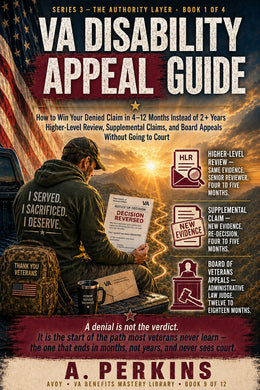
Veterans who want the Board of Veterans' Appeals to review a denied claim have exactly 365 days from the date a VA Regional Office mails its decision to file VA Form 10182, the Decision Review Request: Board Appeal, still widely known as the Notice of Disagreement. Miss that window and the case is closed to Board review; the only paths left are a new claim or a rarely granted extension. The harder problem usually isn't the deadline. It's the choice buried inside the form itself — Direct Review, Evidence Submission, or a Hearing before a Veterans Law Judge — each with a different 2026 wait time. This guide walks through who can file, what evidence to gather first, how to pick a docket, and what happens after the form is submitted.
Key Takeaways
- Confirm the decision date first, because the 365-day clock on VA Form 10182 starts the day the Regional Office mailed the notice, not the day it arrived in the mailbox.
- Choose one Board docket — Direct Review, Evidence Submission, or Hearing — since each carries a different average wait time heading into the back half of 2026.
- Gather evidence before filing if the plan is to use the Evidence Submission docket, which has a defined window for new documents after the form is submitted.
- List every issue by name on the form, because the Board only reviews the specific determinations identified on VA Form 10182, not the claim as a whole.
- File online through VA.gov for the fastest, most trackable submission, or mail a paper form to the Board's Washington, D.C. office if that's preferred.
- Track the docket's average processing time after filing so expectations are realistic and follow-up happens at the right point, not too early or too late.
Table of Contents
- Who Can File a Notice of Disagreement
- Building Your Evidence Before You File
- Filing Strategy: Choosing the Right Board Docket
- How to File VA Form 10182, Step by Step
- After You File: What Happens Next
 |
From the AVOY VA Benefits Mastery Library The VA Disability Appeal Guide covers this in full depth, with step-by-step guidance for exactly this situation. Get the Book → |
Who Can File a Notice of Disagreement
Since the Appeals Modernization Act (AMA) took effect on February 19, 2019, VA Form 10182 has been the only way to request Board of Veterans' Appeals review of a decision issued on or after that date. A veteran, survivor, or dependent can file it after an unfavorable decision from a Regional Office, or after an unfavorable decision from the Higher-Level Review lane or the Supplemental Claim lane. In each case, the person filing is asking a Veterans Law Judge — not a claims processor — to look at the case directly.
The form allows an appellant to contest all or only some of the issues in a decision. Only the issues actually listed on VA Form 10182 go to the Board; anything left off is treated as accepted. That makes the list of issues one of the most consequential parts of the form, especially in decisions covering several conditions at different ratings.
When You Are Not Eligible to Use Form 10182
Decisions dated before February 19, 2019 generally fall under the legacy appeals system, which used VA Form 21-0958. The Board stopped accepting that legacy form as of February 18, 2020, unless the veteran requested and received a specific extension. Veterans with an older, still-pending legacy appeal should confirm with the Board or an accredited representative which system their case is in before filing anything new, since mixing legacy and AMA paperwork on the same issue can create confusion at the Board level. Veterans who haven't yet received any written decision from VA have nothing to disagree with yet — the next step for them is finishing the original claim, not filing an appeal form.
Building Your Evidence Before You File
A Notice of Disagreement doesn't require new evidence to be filed — Direct Review works from the existing record — but veterans who choose Evidence Submission or Hearing should start building their file before the form goes in, not after. The PACT Act, signed in August 2022, expanded presumptive service connection for toxic exposure conditions, and VA reported more than 2.3 million completed PACT Act-related claims for veterans and survivors as of March 2026. Many Board appeals now involve at least one PACT Act presumptive condition, which can change what evidence is actually needed.
Service Treatment Records and Private Medical Evidence
Service treatment records (STRs) establish what happened in service; private medical records establish the current diagnosis and severity. If the original denial turned on a missing nexus — the medical link between a current condition and military service — new private treatment records or an independent medical opinion addressing that link directly are usually the most useful evidence to add on the Evidence Submission docket. Records should be dated and specific, addressing the exact condition and rating criteria at issue in the decision being appealed, not general health history.
Lay Statements and PACT Act Presumptive Conditions
Buddy statements from fellow service members, family members, or supervisors can fill gaps that official records don't cover, particularly for events that were never documented in real time, such as combat exposure or in-service injuries handled without a formal sick call visit. For conditions covered by PACT Act presumptions — including several respiratory illnesses and cancers linked to burn pit and airborne hazard exposure — evidence should focus on establishing qualifying service and location, since service connection itself may already be presumed once exposure and diagnosis are shown.
Filing Strategy: Choosing the Right Board Docket
VA Form 10182 requires picking one of three dockets, and this choice functions as the appellate equivalent of choosing between a Standard Claim and a Fully Developed Claim at the initial filing stage — it trades speed against thoroughness. According to the Board of Veterans' Appeals' own reporting through March 2026, the Direct Review docket, which uses only the existing record with no hearing and no new evidence, had an average days-pending figure of 212 days. The Evidence Submission docket, which allows new evidence for a set period after filing, averaged 260 days pending and remained well under the Board's long-standing 550-day target for that lane. The Hearing docket, which adds a live or virtual hearing before a Veterans Law Judge, has historically run the longest; the Board began shifting additional resources to it in late 2025 and reported its average days-pending figure falling from a January 2026 peak, moving toward the Board's 730-day goal for that docket.
Direct Review vs. Evidence Submission vs. Hearing
Direct Review fits cases where the existing record is already strong and the disagreement is about how VA weighed the evidence, not what evidence exists. Evidence Submission fits cases missing one identifiable piece — a nexus letter, an updated diagnosis, a specific lay statement — that can be gathered and submitted quickly after filing. The Hearing docket fits cases where testimony matters: explaining symptoms, describing an in-service event, or clarifying a timeline that documents alone don't capture. Choosing Hearing when the case doesn't need testimony adds wait time without adding strength to the appeal.
How to File VA Form 10182, Step by Step
- Confirm the decision date on the notice letter and calculate the 365-day deadline from that mailing date, not the date it was opened or read.
- Decide which issues to appeal and list each one specifically, matching the language used in the decision letter.
- Choose a docket — Direct Review, Evidence Submission, or Hearing — based on whether new evidence or testimony is actually needed.
- Submit the form through the method that fits the situation and timeline.
- Save the confirmation and set a reminder to check status periodically rather than waiting for a letter to arrive unannounced.
Filing Online Through VA.gov
Filing through VA.gov is generally the fastest and most trackable method, since the submission is timestamped immediately and can be checked later through the same account used to file the original claim. Online filing also reduces the risk of a form arriving late due to mail delays, which matters given the strict 365-day window.
Filing by Mail or In Person
VA Form 10182 can also be delivered to any VA Regional Office, which forwards it to the Board, or mailed directly to the Board of Veterans' Appeals, PO Box 27063, Washington, D.C. 20038. Paper filers should keep a copy of the completed form and proof of mailing, since the postmark date — not the date the Board logs it — is what counts against the deadline.
After You File: What Happens Next
Once VA Form 10182 is received, the case is assigned to the docket selected on the form and enters the queue for that lane. Veterans on the Evidence Submission docket have a defined window to submit additional records; veterans on the Hearing docket wait for a hearing to be scheduled before the case moves toward a decision. A case doesn't automatically go back for a new Compensation & Pension exam at the Board stage — that typically already happened earlier in the process — but a Veterans Law Judge can order additional development, including a new exam or medical opinion, if the existing record is genuinely insufficient to decide the appeal.
What a Veterans Law Judge Reviews
A Veterans Law Judge reviews the claims file, any newly submitted evidence, and hearing testimony if one was held, then issues a written decision on each issue listed on the form. The decision can grant the appeal, deny it, or remand it back to the Regional Office for further development — a partial outcome that is common when only part of the evidentiary record needs to be completed.
If the Board Denies Your Appeal
A denial from the Board is not the final word. Veterans can appeal that decision to the U.S. Court of Appeals for Veterans Claims (CAVC), or, in many cases, file a new Supplemental Claim if new and relevant evidence becomes available after the Board's decision. Each path has its own deadline and evidentiary standard, so the right next step depends heavily on why the Board denied the appeal in the first place.
Ready to Map Your Own Timeline?
Every one of these choices — which docket, which issues, which evidence — depends on the specifics of a single decision letter. The Free VA Claim Readiness Test at avoyvet.com walks through those specifics and points toward the educational resources that match a veteran's actual situation, whether that's a first-time claim, a denial, or a Board appeal already in progress. It takes a few minutes and produces a plain-language starting point instead of a stack of generic advice.
Frequently Asked Questions
1. What is the difference between a Notice of Disagreement and a Supplemental Claim?
A Notice of Disagreement (VA Form 10182) sends a case directly to the Board of Veterans' Appeals for review by a Veterans Law Judge. A Supplemental Claim goes back to the Regional Office and requires new and relevant evidence that wasn't part of the original decision. The Board appeal lane doesn't require new evidence for the Direct Review docket, while a Supplemental Claim always does. Veterans choosing between the two should consider whether they actually have new evidence: if yes, a Supplemental Claim may resolve faster; if the disagreement is about how existing evidence was weighed, a Board appeal is often the more direct route.
2. How long do I have to file VA Form 10182?
The deadline is one year — 365 days — from the date the Regional Office mailed the decision being appealed, not the date it was received or read. This deadline is strict, and missing it generally closes off Board review of that specific decision. Veterans who are close to the deadline and unsure which docket to choose should still file the form on time and select a docket based on their best information at that moment; the docket choice matters less than getting the form filed before the window closes.
3. Can I request a hearing after choosing Direct Review?
Generally, no. The docket selected on VA Form 10182 determines how the case proceeds, and switching from Direct Review to a Hearing docket after filing typically isn't available in the same way withdrawing and refiling would be. Veterans who are uncertain whether testimony will matter to their case should weigh that uncertainty before submitting the form, since the Hearing docket takes longer but preserves the option to explain the case in person to a Veterans Law Judge.
4. What happens if VA mailed my decision but I never received it?
The 365-day deadline is measured from the mailing date on the decision letter, which VA maintains records of separately from a veteran's own mail. If a decision letter genuinely never arrived, veterans should contact VA or an accredited representative as soon as they become aware of the decision, since there are limited circumstances where a late filing can still be accepted. Waiting to address a missed decision only shrinks the available options further.
5. Do I need a lawyer or VSO to file a Notice of Disagreement?
No, VA Form 10182 can be filed directly by the veteran. That said, accredited Veterans Service Officers (VSOs) can help review the decision letter, identify which issues to list, and choose a docket, often at no cost. Attorneys and claims agents accredited by VA can also assist, typically for a fee tied to any past-due benefits awarded. The form itself doesn't require representation, but the strategic choices inside it — which issues, which docket, what evidence — are exactly where experienced help tends to matter most.
6. Can I add new issues to my Notice of Disagreement after filing?
Generally, only the issues specifically listed on the original VA Form 10182 are considered by the Board. If an additional issue needs review, the more reliable path is usually a separate decision review request for that issue rather than assuming it will be added automatically. Veterans should treat the issues list on the form as final at the time of submission and double-check it carefully before filing.
7. What happens after the Board of Veterans Appeals makes a decision?
A Board decision can grant the appeal, deny it, or remand part or all of it back to the Regional Office for further development. A denial can be appealed to the U.S. Court of Appeals for Veterans Claims, and in many situations a veteran can also file a new Supplemental Claim if new and relevant evidence becomes available afterward. The right next step depends on the specific reasons the Board gave for its decision, which is why reading the decision itself carefully is the first step after it arrives.
Educational information only — not legal, medical, or claim representation, and not affiliated with the U.S. Department of Veterans Affairs. For help filing or appealing, contact a VA-accredited VSO (often free), claims agent, or attorney. For current rates, forms, and deadlines, see VA.gov.