A denial letter that reads "not service connected" is one of the most common — and most misread — outcomes in the VA disability system. The Board of Veterans' Appeals alone adjudicated 123,962 appeals in fiscal year 2025, a 7% increase over the record 116,192 decisions it issued in FY 2024, and a large share of those cases began with exactly this language. The pain point is real: the words sound final, as though VA has ruled the condition unrelated to service forever. It has not. Under 38 CFR 3.303, service connection rests on three provable elements, and a "not service connected" denial almost always means one of those three was missing from the file — not that it cannot be supplied.
Key Takeaways
- Read the "Reasons for Decision" section first — it names the missing element.
- Identify which element under 38 CFR 3.303 failed: diagnosis, in-service event, or nexus.
- Recognize the denial as a finding on the evidence submitted, not a permanent bar.
- Preserve the effective date by acting within one year of the decision letter date.
- Match the review lane to the defect — new evidence, adjudicator error, or a judge.
- Apply the benefit-of-the-doubt rule at 38 CFR 3.102 when evidence is in balance.
Table of Contents
- What "Not Service Connected" Actually Means
- Reading the Denial Letter and Finding the Real Reason
- The Evidence Gap Behind Most Denials
- Choosing the Right Next Move
- What Happens After the Next Filing
 |
From the AVOY VA Benefits Mastery Library The VA Disability Appeal Guide — Series 3 Bk 1 covers this in full depth, with step-by-step guidance for exactly this situation. Get the Book → |
What "Not Service Connected" Actually Means
Veterans read the phrase and hear a verdict on their service. That is not what the rater wrote. "Not service connected" is a technical finding that the evidence in the claims file, as it existed on the date of decision, did not establish the legal link between a current disability and military service.
The governing regulation is 38 CFR 3.303, which sets out the principles relating to service connection. Direct service connection requires three elements: a current diagnosed disability, an in-service injury, event, or disease, and a medical nexus connecting the two. Miss any one of the three and the claim is denied — even when the other two are documented beyond question. A veteran with flawless deployment records and a clear current diagnosis will still see "not service connected" if no medical opinion ties them together.
The standard of proof is lower than most veterans assume. Under 38 CFR 3.102, when a reasonable doubt arises regarding service origin, the degree of disability, or any other point, that doubt is resolved in favor of the claimant. Reasonable doubt exists when positive and negative evidence are in approximate balance. The evidence does not have to prove the case outright; it has to reach equipoise. That is the "at least as likely as not" threshold veterans hear about, and it explains why a single well-reasoned medical opinion can change the outcome of a denied claim.
Why the Wording Matters Less Than the Reasoning
Two decisions can both say "not service connected" for entirely different reasons — one because no diagnosis of record existed, another because the examiner found the condition pre-existed service. The phrase itself carries no information about strategy. The reasoning paragraphs do. Treating the phrase as the decision, rather than the explanation beneath it, is how veterans end up refiling the same claim with the same gap and receiving the same answer.
Reading the Denial Letter and Finding the Real Reason
The frustration most veterans describe is not the denial itself but the packet — pages of boilerplate with the operative sentence buried inside. VA includes Form 20-0998, "Your Right to Seek Review of Our Decision," with rating decisions precisely because the next step depends on what the decision said.
The rating decision has a predictable structure. The "Decision" section lists each issue and its outcome. The "Evidence" section lists every record VA considered — worth checking line by line, because records the veteran believes were submitted are sometimes absent. The "Reasons for Decision" section is where the denial is explained, and it is the only section that matters for planning the next move.
Read that section slowly and literally. VA raters write to the regulation, so the sentence that ends the claim is usually a single clause describing which element the evidence failed to establish. Underline it. Everything that follows — what evidence to gather, which review lane to use, whether a new medical opinion is needed — flows from that one clause and from nothing else in the packet.
Locate the Missing Element
Read the reasoning against the three-element test. Language such as "no current diagnosis was found" points to element one. "Service treatment records are silent for" points to element two. "The examiner opined that it is less likely than not related to service" points to element three, the nexus — and by most practitioner accounts, the nexus is the element that fails most often.
Check What VA Never Saw
Compare the evidence list against a personal inventory of records: service treatment records, private treatment notes, deployment orders, unit records, and lay statements. A denial resting on an incomplete file is a different problem from a denial resting on a complete one, and it may implicate VA's duty to assist. Requesting the full claims file — the C-file — resolves the question definitively rather than by memory.
The Evidence Gap Behind Most Denials
Most "not service connected" denials trace to one of three recurring evidence gaps, and each has an established regulatory path around it. The pain point here is predictable: veterans resubmit the same records, more forcefully argued, and receive the same outcome, because argument does not close an evidentiary gap.
Gap one — no current diagnosis. A symptom is not a disability under VA law. Pain, fatigue, or difficulty sleeping described without a clinical diagnosis leaves element one unmet. The remedy is a current examination and diagnosis from a treating provider, VA or private.
Gap two — no documented in-service event. Service treatment records are frequently silent, especially for conditions veterans did not report at the time. Silence is not fatal. 38 CFR 3.303(b) permits service connection through chronicity or continuity of symptomatology — a documented pattern of the same symptoms from service forward. Lay statements from those who served alongside the veteran, and from family who observed the changes, are competent evidence of what was observable.
Gap three — no nexus. This is the element that decides most contested claims. A nexus opinion is a medical professional's reasoned statement that the current condition is at least as likely as not related to service, supported by rationale rather than conclusion. An opinion that states a conclusion without explaining the medical reasoning behind it carries little weight in adjudication.
When the Path Runs Through Another Condition
A condition denied on a direct basis may still be compensable as secondary. Under 38 CFR 3.310, a disability that is proximately due to, or aggravated by, an already service-connected disease or injury is itself service connected. A back condition denied directly may connect through a service-connected knee that altered gait. The claim is not the same claim, and it is not blocked by the earlier denial.
Choosing the Right Next Move
VA offers three decision review options, and choosing by habit rather than by defect is a common and costly error. For most benefits, a Higher-Level Review or Board Appeal must be requested within one year of the date on the decision letter, and VA advises filing a Supplemental Claim within that same window to preserve the original effective date — the date that determines how far back any eventual award reaches.
The sequence that follows is educational, not a substitute for accredited representation:
- Request the C-file. Obtain the complete claims file so the analysis rests on what VA actually holds, not on assumption.
- Identify the failed element. Map the "Reasons for Decision" language to element one, two, or three.
- Close the gap with evidence. Obtain the diagnosis, the lay statements, or the reasoned nexus opinion the file lacks.
- Select the lane. Match the review option to the defect rather than to what a friend filed.
- File within the one-year window. Submit before the anniversary of the decision letter date to protect the effective date.
Matching the Lane to the Defect
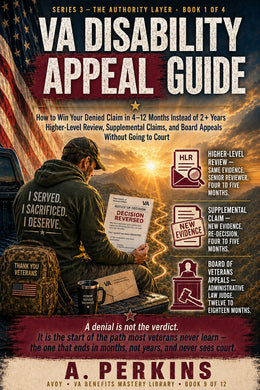
A Supplemental Claim is for new and relevant evidence VA did not previously consider — the correct lane when the file was missing a diagnosis, a nexus opinion, or lay statements. It may be filed at any time, though VA recommends filing within one year of the decision letter to keep the effective date. A Higher-Level Review sends the existing record to a more senior adjudicator to look for a factual or legal error; no new evidence may be submitted, which makes it the wrong lane for an evidence gap and the right one when the rating criteria were misapplied. A Board Appeal places the case before a Veterans Law Judge and must be requested within one year of the decision letter date.
What Happens After the Next Filing
Expectations matter as much as strategy. Veterans who assume every path moves at the same speed make decisions that cost months. In fiscal year 2025, appeals on the Board's evidence submission docket were pending an average of 713 days, while direct docket appeals averaged 506 days. Supplemental Claims and Higher-Level Reviews are processed at the regional office level and generally resolve considerably faster, but current national averages shift month to month and should be checked on VA.gov rather than assumed.
A new decision can go three ways. It may grant the benefit, in which case the effective date determines retroactive payment. It may deny again, which opens a fresh one-year window and a fresh choice of lane. Or, at the Board, it may be remanded — returned to the regional office for further development. A remand is not a loss; it is an instruction that something was left undone.
Tracking matters during the wait. Claim status is visible on VA.gov, and requests for additional evidence carry response deadlines that, if missed, can lead to a decision on an incomplete record. Watching for those letters is the difference between a file that keeps moving and one that stalls quietly.
If a New Examination Is Ordered
A Supplemental Claim supported by new evidence often triggers a new VA examination. The examination is where the file becomes a person. Describing the condition at its worst — the flare days, not the good ones — and describing functional impact rather than sensation gives the examiner the information the rating criteria actually require.
If the Denial Repeats
A second denial on the same reasoning usually signals that the gap was not closed, only re-argued. That is the point to re-read the new reasoning paragraphs against the three elements, and to consider whether accredited representation — a VA-accredited VSO, claims agent, or attorney — should take the file forward. VSO assistance is frequently available at no cost.
Take the Next Step
A denial that reads "not service connected" is a description of a file, not a judgment on a career. The veterans who move past it are the ones who identify the missing element precisely and close it with evidence rather than argument. The free VA Claim Readiness Test at avoyvet.com walks through the three elements of service connection and shows where a file currently stands — before another year runs off the clock. AVOY Veteran Navigator AI is available on the same site for educational guidance on denials, evidence, and decision review options.
Frequently Asked Questions
Does "not service connected" mean the condition can never be service connected?
No. The finding applies to the evidence in the file on the date of the decision, not to the condition permanently. If the denial rested on a missing nexus opinion and a reasoned opinion is later obtained, the file is materially different and can be reviewed on that basis. The same is true where a diagnosis was absent and is later established, or where lay statements document a continuity of symptoms that service treatment records did not capture. What does not change the outcome is resubmitting identical evidence with stronger wording. The three elements under 38 CFR 3.303 are met with records and medical opinions, not with emphasis.
How long is there to respond to a "not service connected" decision?
For most VA benefits, a Higher-Level Review or Board Appeal must be requested within one year of the date printed on the decision letter. A Supplemental Claim may be filed at any time, but VA advises filing within that same one-year window to preserve the original effective date. The effective date matters because it sets how far back retroactive payment reaches if the claim is eventually granted. Missing the window does not end the claim, but it can reset the effective date to the later filing — a difference often measured in months of back pay. The date to track is the one printed on the letter, not the date it arrived.
Which review lane is correct when the file was missing evidence?
A Supplemental Claim is the lane built for new and relevant evidence VA has not previously considered. Higher-Level Review does not accept new evidence — it asks a senior adjudicator to find a factual or legal error in the record as it stands — so filing there with a new nexus letter wastes the filing. A Board Appeal places the case before a Veterans Law Judge and, depending on the docket selected, may or may not accept new evidence. Matching the lane to the actual defect is the most consequential choice after a denial — and the one veterans most often make by habit.
What makes a nexus opinion strong enough?
Weight comes from rationale, not from the conclusion. An opinion stating that a condition is "at least as likely as not" related to service, without explaining the medical basis, is easily outweighed. A strong opinion identifies the in-service event, describes the mechanism by which it produced or aggravated the current condition, cites the records reviewed, and addresses contrary evidence in the file — including any unfavorable VA examination. The provider's qualifications relative to the condition also matter. The standard is not certainty; it is a reasoned explanation sufficient to place the evidence in at least approximate balance under 38 CFR 3.102.
Can a condition be claimed as secondary after a direct denial?
Yes. 38 CFR 3.310 provides service connection for a disability that is proximately due to, or aggravated by, an already service-connected condition. A direct denial addresses whether the condition arose in service; it does not address whether an established service-connected disability later caused or worsened it. These are separate legal theories with separate evidentiary requirements. The secondary theory still needs a medical opinion, but the opinion links the new condition to the service-connected one rather than to service itself — which is frequently an easier link to document, because the intervening disability is already established in the record.
What does a remand from the Board mean?
A remand returns the appeal to the regional office because something necessary was not completed — records were not obtained, an examination was inadequate, or a required opinion was never sought. It is not a denial and it is not an approval. It is an instruction from a Veterans Law Judge that development must be finished before the case can be decided. Remands add time, and Board timelines are already substantial: evidence submission docket appeals averaged 713 days pending in fiscal year 2025. But a remand indicates the Board identified a defect in how the claim was handled, which is meaningfully different from a decision on the merits.
Is professional help necessary after a denial?
It is not required, and many veterans file successful Supplemental Claims independently. VA-accredited Veterans Service Organizations provide representation at no cost and can review a decision, request the C-file, and prepare the next filing. Accredited claims agents and attorneys may charge regulated fees and are typically engaged for complex or long-running appeals. What matters more than the choice of helper is that whoever handles the file reads the "Reasons for Decision" section against the three elements and closes the specific gap identified there.
Educational information only — not legal, medical, or claim representation, and not affiliated with the U.S. Department of Veterans Affairs. For help filing or appealing, contact a VA-accredited VSO (often free), claims agent, or attorney. For current rates, forms, and deadlines, see VA.gov.