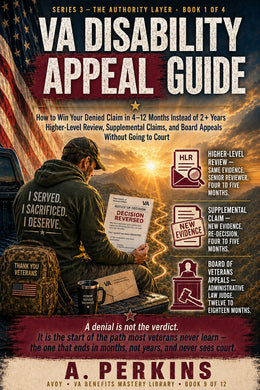
Under the Appeals Modernization Act, a veteran has one year -- 365 days -- from the date printed on a VA decision letter to request a Higher-Level Review or a Board Appeal. The pain is that most veterans read a denial, set it aside to deal with later, and discover months afterward that the calendar quietly took something. It did not just take an appeal option. It took the effective date, and with it every month of retroactive pay tied to the original claim. This guide explains how the one-year VA appeal deadline works in 2026, what breaks the chain called continuous pursuit, and how to keep the earliest possible effective date attached to a claim.
Key Takeaways
- Mark the date on the decision letter -- not the date it was opened -- as day one.
- File one of the three review options within one year to keep continuous pursuit intact.
- Recognize that a Supplemental Claim filed after one year breaks the chain and moves the effective date forward.
- Choose the review lane that matches the reason for the denial, not the lane that sounds fastest.
- Document every submission date, because the effective date argument depends on proof of timely filing.
- Escalate correctly after a Board decision, where the clock changes from 365 days to 120.
Table of Contents
- Who the One-Year Clock Applies To
- What Starts the Clock and What Proves It Was Met
- Choosing the Review Lane That Preserves the Date
- Step-by-Step: Protecting the Effective Date
- After the Deadline Passes: What Can and Cannot Be Recovered
- Frequently Asked Questions
 |
From the AVOY VA Benefits Mastery Library The VA Disability Appeal Guide covers this in full depth, with step-by-step guidance for exactly this situation. Get the Book → |
Who the One-Year Clock Applies To
Every veteran, surviving spouse, dependent, or claimant who receives a VA decision letter is standing on a clock, whether or not they know it. VA states plainly that for most benefits, the claimant has one year from the date on the decision letter to request a Higher-Level Review or a Board Appeal. That single rule governs compensation denials, rating percentages considered too low, disputed effective dates, dependency and indemnity compensation decisions, and pension determinations.
The pain point is that the letter does not read like a deadline notice. It reads like a verdict. Many veterans assume a denial is final, or assume filing a brand-new claim later accomplishes the same thing. Neither assumption holds. The decision letter opens a one-year window in which the claimant controls what happens next -- and once it closes without action, control shifts to the calendar.
The clock also applies to partial grants. A veteran granted service connection at 10 percent when the evidence supports more has received a decision, and the same 365 days apply to disputing that percentage. Waiting two years and then filing for an increase is a different action with a different effective date.
Claimants Who Are Often Caught Off Guard
Three groups lose the window most often. First, veterans who receive a grant on one condition and a denial on another, and who focus only on the good news. Second, survivors handling a claim during grief, when mail sits unopened. Third, veterans who move without updating an address with VA, because the mailing date starts the clock regardless of when the envelope is read. The remedy is the same discipline in each case: open every VA envelope on arrival, write the decision date on a calendar, and set a personal action deadline at least sixty days before the one-year mark.
What Starts the Clock and What Proves It Was Met
The clock starts on the date VA mailed the notice of decision. For a Board Appeal, the rule is stated with precision: a completed VA Form 10182 must be postmarked or received by the Board within one year -- 365 days -- from the day the local VA office mailed the notice of the decision. The relevant date is printed on the face of the decision, not on the envelope, and not on the day the veteran happened to read it.
That precision cuts both ways. It creates a hard deadline, and it also creates a provable one. A claimant who can show the mailing date and the submission date has the entire effective-date argument in two documents. The evidence discipline that wins claims is the same discipline that protects deadlines: keep the paper, date the paper, and store it where it can be found in a hurry.
The Three Documents to Preserve
Keep the decision letter itself, including the code sheet and the reasons-and-bases narrative, because it identifies the exact issue decided and the exact date. Keep proof of submission -- the VA.gov confirmation screen, the confirmation email, or a certified mail receipt with a postmark. Keep a copy of the completed form as submitted. Those three items answer every question a reviewer can raise about timeliness.
Evidence That Supports the Underlying Issue
Meeting the deadline preserves the date; evidence wins the issue. Service treatment records, private treatment records, a nexus opinion addressing the specific gap the decision identified, lay statements from people who observed the symptoms, and PACT Act presumptive documentation for toxic-exposure claims all belong in the file. For a Supplemental Claim, VA requires new and relevant evidence -- new meaning information not previously submitted, relevant meaning information that tends to prove or disprove a matter at issue. Filing on time with nothing new attached preserves a date but rarely changes an outcome.
Choosing the Review Lane That Preserves the Date
Three lanes exist under the modernized system, and all three preserve continuous pursuit when filed within the one-year window. The Higher-Level Review, filed on VA Form 20-0996, asks a senior reviewer to look at the same evidence and find an error. No new evidence is permitted. VA's stated goal for Higher-Level Reviews not related to health care benefits is an average of 125 days, making it the fastest formal option when the file already contains what it needs and the problem was how that file was read.
The Supplemental Claim, filed on VA Form 20-0995, is the lane for new and relevant evidence. It is the right answer when the decision denied for a missing nexus opinion, a missing current diagnosis, or a missing service record -- gaps a senior reviewer's second look cannot cure. It may be filed at any time, but the timing rule matters enormously and is covered below.
The Board Appeal, filed on VA Form 10182, sends the issue to a Veterans Law Judge and offers three dockets: Direct Review, Evidence Submission, and Hearing. It fits when the disagreement is with how the law was applied rather than with what evidence exists.
Matching the Lane to the Denial Language
The decision letter states its own reason, and that reason points to the lane. Language about evidence not showing a link to service points toward a Supplemental Claim with a nexus opinion. Language misstating a fact already in the record -- a wrong separation date, an overlooked treatment note -- points toward a Higher-Level Review. A rating criterion the veteran believes was applied incorrectly points toward the Board. Selecting a lane by speed alone is one of the most common and most expensive mistakes in the process.
Step-by-Step: Protecting the Effective Date
The governing rule appears at 38 CFR 3.2500. The effective date is fixed by the date of receipt of the initial claim or the date entitlement arose, whichever is later, if the claimant continuously pursues the issue by timely filing, in succession, any available review option within one year of each decision. That phrase -- continuously pursues -- is the whole game. Five steps operationalize it.
- Record day one. Write the decision letter's date on a calendar and count forward 365 days. Set a working deadline at day 300 to leave room for gathering records.
- Identify the issue and the reason. Read the reasons-and-bases section and write, in one sentence, what VA said was missing. Every later choice flows from that sentence.
- Select the lane. Match the reason to Higher-Level Review, Supplemental Claim, or Board Appeal. One issue may go to one lane while a second in the same letter goes to another.
- Assemble and submit inside the window. Complete the correct form, attach the evidence, and submit through VA.gov or by mail with proof of postmark. Confirm the submission is date-stamped.
- Repeat on every subsequent decision. Each new decision starts a new one-year clock. Filing again within that year keeps the chain unbroken back to the original claim date.
Why the Chain Matters More Than Any Single Filing
Continuous pursuit is a sequence, not a single act. A veteran who files a claim in 2023, receives a denial, files a Supplemental Claim within one year, receives another denial, and files a Board Appeal within one year of that has kept an unbroken chain. If the claim is eventually granted, the effective date reaches back to that original filing. A veteran who lets fourteen months elapse at any link has broken it, and the date resets forward.
Handling Multiple Issues in One Letter
Decision letters often address several conditions at once. Each issue carries its own deadline running from the same letter date, and each may be routed to a different lane. Splitting them by denial reason prevents a weak issue from slowing a strong one.
After the Deadline Passes: What Can and Cannot Be Recovered
Missing the one-year mark does not end the claim, and this deserves emphasis. A Supplemental Claim may still be filed at any time with new and relevant evidence. What changes is the money. Where VA receives a Supplemental Claim after expiration of the one-year period, continuous pursuit is broken and VA applies the standard effective date provisions -- generally the date of the new filing -- unless VA grants an extension for good cause shown under 38 CFR 3.109(b).
Good cause is a narrow door. It requires extenuating circumstances outside the claimant's control and a showing of due diligence. Hospitalization, incapacity, or a documented failure of VA's own notice can support such a request. Simple delay or confusion about the process generally will not.
Wait times in 2026 give practical reason to act early rather than at the last week. The Board's average days pending for the Direct Review docket has stayed below 220 days for most of fiscal year 2026 and stood at 212 days as of March 2026, while the Evidence Submission docket averaged 260 days over the same period. Those figures represent real improvement over prior years, but they still mean that a decision to appeal is a decision measured in months.
The Clock Changes After a Board Decision
Once the Board issues a decision, the one-year rule no longer applies to a court challenge. A Notice of Appeal must be received by the U.S. Court of Appeals for Veterans Claims no later than 120 days after the date the Board mailed the notice of its decision, and the appeal is filed with the Court, not with VA. A $50 filing fee or a Declaration of Financial Hardship is due within 14 days of the Notice of Appeal. A Supplemental Claim filed with the regional office remains an option after a Board decision as well, and the same one-year continuous-pursuit rule applies to it.
Rebuilding After a Broken Chain
When the chain is broken, strategy shifts from preserving an old date to building the strongest possible case for a new one: a current diagnosis, a well-supported medical opinion connecting the condition to service, and a clear symptom record. The lost retroactive period cannot be recovered by argument alone, but a well-built new filing still secures benefits going forward -- and that is where most of a claim's lifetime value sits.
Take the Next Step
Deadlines are the least forgiving part of the VA system and the easiest part to control. A veteran who knows the date on the letter, knows which lane fits the denial, and files inside the window has already outperformed most of the field. The Free VA Claim Readiness Test at avoyvet.com walks through a current claim or denial step by step, identifies which review option fits, and flags the evidence gaps a filing needs to close. Take the readiness test at avoyvet.com, then ask AVOY Veteran Navigator AI any follow-up question about deadlines or effective dates.
Frequently Asked Questions
Does the one-year clock start when the letter is dated or when it arrives?
The controlling date is the date VA mailed the notice of decision, printed on the decision letter itself. For a Board Appeal, VA Form 10182 must be postmarked or received by the Board within 365 days from the day the local VA office mailed that notice. Mail delivery time, forwarding delays, and the day the envelope was opened do not extend the window. This is why address accuracy with VA matters, and why the practical rule is to treat the printed decision date as day one.
Is a Supplemental Claim really unlimited in time?
A Supplemental Claim may be filed at any time as long as new and relevant evidence is submitted. The limitation is financial rather than procedural. When one is received more than a year after the decision, continuous pursuit is broken and VA applies the standard effective date provisions, generally making the effective date the date of the new filing rather than the original claim. VA may grant an extension for good cause under 38 CFR 3.109(b), but that requires extenuating circumstances outside the claimant's control and evidence of due diligence.
Which review option is fastest?
VA's stated goal for Higher-Level Reviews not related to health care benefits is an average of 125 days, making it generally the quickest of the three formal options. Speed alone is a poor selection criterion. A Higher-Level Review does not permit new evidence, so a denial based on a missing nexus opinion or diagnosis will usually be denied again on review. Matching the lane to the stated reason produces better outcomes than optimizing for turnaround time. Timelines are goals, not guarantees.
Do all issues in one decision letter share one deadline?
Each issue decided in the letter carries its own one-year window, and all of those windows run from the same decision date. Nothing requires the issues to be appealed together or through the same lane. A veteran might send one condition to Higher-Level Review because the record was misread, send a second to a Supplemental Claim because a nexus opinion is needed, and let a third stand. Splitting by denial reason prevents a slow-developing issue from holding back one that is ready now.
What happens to the effective date if a claim is granted after several rounds of review?
Under 38 CFR 3.2500, the effective date is fixed by the date of receipt of the initial claim or the date entitlement arose, whichever is later, provided the claimant continuously pursued the issue by timely filing an available review option within one year of each decision. An unbroken chain of timely filings reaches back to the original claim, and that is where retroactive pay is calculated from. A gap of more than one year at any link generally breaks the chain and moves the effective date forward to the later filing, which is why tracking each new decision date matters as much as tracking the first one.
How long does a Board Appeal take in 2026?
Board wait times have improved substantially. Average days pending for the Direct Review docket has remained below 220 days for most of fiscal year 2026 and stood at 212 days as of March 2026, while the Evidence Submission docket averaged 260 days through the same month. The Board issued an average of nearly 90,000 modernized decisions in fiscal years 2024 and 2025 after staffing increases. Hearing dockets generally take longer. Confirm current figures on VA.gov, since they shift with workload.
What is the deadline to appeal a Board decision to court?
A Notice of Appeal must be received by the U.S. Court of Appeals for Veterans Claims no later than 120 days after the date the Board mailed notice of its decision. It is filed with the Court directly, not with VA. The Notice must include current name, address, telephone number, email if available, the VA claims file number, and the date of the Board decision appealed. A $50 nonrefundable filing fee or a Declaration of Financial Hardship must reach the Court within 14 days after the Notice is sent.
Educational information only -- not legal, medical, or claim representation, and not affiliated with the U.S. Department of Veterans Affairs. For help filing or appealing, contact a VA-accredited VSO (often free), claims agent, or attorney. For current rates, forms, and deadlines, see VA.gov.