In July 2026, VA closed Supplemental Claims for disability compensation and pension in an average of 58.8 days, well under its 125-day goal, according to VA.gov. For a veteran holding a denial letter, that speed only matters if the claim actually reopens. VA will not reconsider a denied claim simply because a veteran resubmits paperwork or asks for a second look. Under 38 CFR 3.2501, the agency of original jurisdiction readjudicates a case only when new and relevant evidence enters the file: evidence that was not previously part of the record and that tends to prove or disprove something at issue. This guide breaks down exactly what qualifies, what does not, and how to build a Supplemental Claim VA cannot wave off.
Key Takeaways
- Identify evidence that is new (not already in the file) and relevant (it proves or disproves something VA questioned).
- Gather a nexus opinion, updated treatment records, or a lay statement rather than resubmitting documents VA already reviewed.
- File VA Form 20-0995 to open a Supplemental Claim, or use the online tool if the claim is for disability compensation.
- Redirect worsened-condition claims to a claim for increased compensation instead of a Supplemental Claim.
- Ask VA to gather federal or private records by naming the treating facility and approximate dates.
- Escalate to a Higher-Level Review or Board Appeal if a Supplemental Claim is denied again for insufficient evidence.
Table of Contents
- Who Can File a Supplemental Claim
- Gathering New and Relevant Evidence
- Filing Strategy: Complete Application vs. Evidence VA Gathers For You
- Step-by-Step: Submitting Your Supplemental Claim
- After You File: Review, Decision, and Next Steps
 |
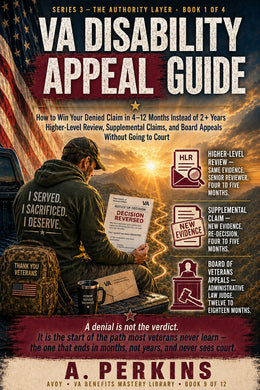
From the AVOY VA Benefits Mastery Library The VA Disability Appeal Guide covers this in full depth, with step-by-step guidance for exactly this situation. Get the Book → |
Who Can File a Supplemental Claim
A veteran qualifies to file a Supplemental Claim under two conditions that must both be true: VA has already decided the claim, and the claim is not a contested claim between multiple parties. Beyond that, the veteran must meet at least one more condition — either new and relevant evidence exists to submit, or the claim now qualifies for a newly presumptive condition under a change in law, such as the PACT Act. As of August 2025, supplemental claims made up roughly 41 percent of VA's active claims inventory for new or worsening conditions, with AMA supplemental decision review requests accounting for another 28 percent of the broader review docket, according to VA claims processing data. That volume reflects how often the first decision on a claim is not the final word, and how many veterans are working through this exact process right now.
The two paths into a Supplemental Claim work differently. A veteran using the evidence path has to show VA something it has not already considered and that speaks directly to the reason for denial. A veteran using the change-in-law path, most commonly a PACT Act presumptive condition, does not need new evidence of service connection at all — VA already presumes the connection for qualifying service. That veteran only needs to submit or identify evidence documenting the diagnosis and severity of the condition itself.
When a Supplemental Claim Is the Wrong Tool
VA is explicit on one point: a Supplemental Claim is not the correct filing if a service-connected condition has simply gotten worse. A worsened condition calls for a claim for increased disability compensation, filed through VA Form 21-526EZ, not a decision review. Filing the wrong form can cost weeks of processing time and, in some cases, the earlier effective date a veteran would have otherwise protected. Veterans unsure which lane applies — a rating dispute versus a worsening condition — should confirm the reason for the prior decision before choosing a filing path.
Gathering New and Relevant Evidence
The single biggest reason Supplemental Claims fail is not weak evidence — it is evidence that is not new. VA Form 20-0995 requires the veteran to identify what has changed, and 38 CFR 3.2501 sets a two-part test that both halves of the record must clear before VA will readjudicate.
What Counts as "New"
New evidence, under the regulation, is evidence that was not previously part of the actual record before the agency adjudicator who made the prior decision. That means VA treatment records the veteran reasonably identifies, and anything VA receives after it issued its decision letter but before the record closed, can count as new even if the underlying event happened years earlier. What does not count is evidence VA already reviewed and rejected the first time, resubmitted without change. A veteran who mails back the same private medical record VA already considered has not met the standard, no matter how important that record feels.
What Counts as "Relevant"
Relevant evidence is information that tends to prove or disprove a matter at issue in the claim — and, notably, the regulation also treats evidence as relevant if it raises a theory of entitlement VA had not previously addressed. In practice, the strongest new and relevant evidence tends to fall into three categories: an updated nexus letter connecting a diagnosed condition to service, a lay or witness statement using VA Form 21-10210 (the form VA introduced in 2021 to replace the older witness-statement version of Form 21-4138), or newly obtained service treatment or federal facility records that were not part of the file when VA made its decision. A strong lay statement includes names, dates, locations, and firsthand observations rather than a diagnosis or a legal conclusion, since VA weighs lay evidence differently than clinical evidence from a licensed provider.
Filing Strategy: Complete Application vs. Evidence VA Gathers For You
Once new and relevant evidence is identified, a veteran has two practical ways to build the Supplemental Claim application, and the choice affects both speed and completeness. The first is filing a complete application: submitting the actual new and relevant evidence with VA Form 20-0995 at the time of filing. The second is identifying evidence VA should gather on the veteran's behalf, such as records from a VA medical center or another federal facility, by naming the facility and treatment dates on the form.
Filing a complete application with the evidence already attached tends to move faster because VA is not waiting on a records request to a third party before it can readjudicate. Identifying evidence for VA to collect is the right move when a veteran cannot obtain a private or federal record independently, but it adds a dependency to the timeline. Under 38 CFR 3.2501(c), submitting a substantially complete Supplemental Claim triggers VA's duty to assist under 3.159, which obligates VA to help secure new and relevant evidence needed to complete the application — but "duty to assist" is not a guarantee of speed, and complex record requests can add months to an otherwise fast process.
Using VA Form 21-4142 for Private Records
If the missing evidence sits with a private doctor or hospital, a veteran should pair the Supplemental Claim with VA Form 21-4142, Authorization to Disclose Information, which allows VA to request those records directly. Filing 21-4142 alongside the Supplemental Claim avoids a second round-trip letter from VA asking for permission to reach out to the provider, which is one of the more common causes of delay in an otherwise straightforward supplemental filing.
Step-by-Step: Submitting Your Supplemental Claim
- Confirm eligibility. Verify the claim was previously decided, is not a contested claim, and either has new and relevant evidence or qualifies under a change in law.
- Collect the evidence. Assemble the nexus letter, buddy statement (Form 21-10210), or newly available treatment records that were not part of the original file.
- Choose the filing method. File online through VA.gov for disability compensation claims — the only claim type currently supported by the online Supplemental Claim tool. All other benefit types require mailing, filing in person at a regional office, or filing with help from a Veterans Service Organization (VSO).
- Complete VA Form 20-0995. List the specific evidence being submitted, or identify the facility and date range for evidence VA should gather, and attach Form 21-4142 if private records are involved.
- Submit and confirm receipt. Send the application to the correct address for the benefit type — disability compensation claims go to the VA Claims Intake Center in Janesville, Wisconsin — and confirm the claim appears on VA's claim status tracker.
Filing With a VSO or Accredited Representative
An accredited attorney, claims agent, or VSO representative can prepare and submit the Supplemental Claim on a veteran's behalf, often at no cost through a VSO. This is particularly useful when the evidence question is close — for example, when it is unclear whether a piece of evidence meets the "relevant" standard — since a representative who reviewed the original denial can better match evidence to the specific reason VA denied the claim.
Requesting a Hearing
A veteran can request a hearing at any point during the Supplemental Claim process, either through VA's Ask VA online contact tool or by phone. A hearing is not required and most Supplemental Claims are decided on the paper record, but it remains an option if a veteran believes oral testimony would clarify the evidence.
After You File: Review, Decision, and Next Steps
Once VA receives a substantially complete Supplemental Claim, the agency of original jurisdiction reviews the full evidentiary record, meaning all evidence received before VA issues its decision — not just the newly submitted documents. If the new and relevant evidence standard is met, VA readjudicates the entire claim. If it is not met, VA issues a decision stating there was insufficient evidence to readjudicate, which is different from a full merits denial and can sometimes be resolved simply by submitting the missing evidence in a follow-up filing.
C&P Exams and the Rating Decision
VA may schedule a new Compensation & Pension exam if the new evidence raises a medical question the existing record does not answer — for instance, a new nexus opinion that VA wants a VA examiner to evaluate directly. Missing a scheduled exam can result in the claim being decided on the evidence already in the file, so veterans should treat any exam notice as a required step, not an optional one.
If VA Denies the Supplemental Claim Again
A veteran who disagrees with the outcome has three options: request a Higher-Level Review of the Supplemental Claim decision, request a Board Appeal for review by a Veterans Law Judge, or file another Supplemental Claim if additional new and relevant evidence becomes available. There is no cap on how many Supplemental Claims a veteran can file over time, which makes this option repeatable as new medical evidence, nexus opinions, or lay statements become available — unlike a Board Appeal, which carries a longer, more formal review track.
Take the Next Step
Figuring out whether a piece of evidence is genuinely new and relevant — or just familiar evidence in a new folder — is where most Supplemental Claims succeed or stall. The Free VA Claim Readiness Test at avoyvet.com walks through the specific reason a claim was denied and helps identify what kind of evidence is actually missing before a veteran spends months waiting on a decision that could have been avoided. Start the free readiness check at avoyvet.com and get a clearer picture of the strongest way back into a claim.
Frequently Asked Questions
Can I file a Supplemental Claim with the same evidence VA already denied?
No. Evidence that was already part of the record when VA made its decision does not meet the "new" half of the standard, regardless of how relevant it seems. VA defines new evidence as information not previously part of the actual record before the adjudicator who decided the claim. Resubmitting an old private medical record, a prior statement, or documents VA already cited in the denial letter will not trigger readjudication. To move a Supplemental Claim forward, a veteran needs something the file did not already contain — an updated nexus opinion, a new lay statement, newly located service records, or documentation identifying a theory of entitlement VA had not previously addressed. If a veteran believes VA overlooked evidence that was already submitted, a Higher-Level Review — not a Supplemental Claim — is typically the more appropriate review option.
What's the difference between "new" and "relevant" evidence?
They are two separate tests, and both must be satisfied. New evidence means information that was not part of the record when VA made its prior decision. Relevant evidence means information that tends to prove or disprove a matter at issue in the claim, including evidence that raises a theory of entitlement VA had not previously considered. Evidence can be new without being relevant — for example, an unrelated medical record from the same time period that does not address the reason for denial. It can also fail the "new" test even if it is highly relevant, if VA already had access to it. A Supplemental Claim only moves forward when a document satisfies both halves of the test at the same time.
How long does a VA Supplemental Claim take in 2026?
As of July 2026, VA reports an average of 58.8 days to complete a Supplemental Claim for disability compensation or pension benefits, according to VA.gov's published processing time data. That is well under VA's stated goal of 125 days for Supplemental Claims not related to health care benefits. Processing time can vary based on complexity — a claim where VA must request records from a private provider or schedule a new C&P exam will generally take longer than one filed with all evidence already attached. Veterans can track their specific claim's status using VA's online claim status tool rather than relying on the published average alone.
Do I need a lawyer or VSO to file a Supplemental Claim?
No, a veteran can file VA Form 20-0995 independently, either online for disability compensation claims or by mail for other benefit types. That said, an accredited attorney, claims agent, or VSO representative can help — often at no cost through a VSO — particularly when it is unclear whether specific evidence meets the new and relevant standard. Because Supplemental Claims are denied specifically for insufficient evidence rather than on the underlying merits, a representative familiar with the original denial letter can help identify what evidence is actually missing rather than what merely feels important to the veteran.
Can I submit a buddy statement as new and relevant evidence?
Yes. A lay or witness statement, filed on VA Form 21-10210, is a recognized form of evidence that VA will weigh alongside medical evidence. VA introduced Form 21-10210 in 2021 to replace the older witness-statement format previously submitted on Form 21-4138. A buddy statement works best when it comes from someone with firsthand knowledge — a fellow service member who witnessed an in-service event, or a spouse or friend who has observed symptoms over time — and when it sticks to specific, dated observations rather than a diagnosis or a legal conclusion about service connection. A buddy statement cannot replace a medical nexus opinion, but it can be the evidence that makes an existing medical record relevant for the first time.
What happens if VA says there wasn't enough new and relevant evidence?
VA will issue a decision stating there was insufficient evidence to readjudicate the claim. This is a distinct outcome from a full merits denial — it means VA did not find evidence meeting the new and relevant standard, not that VA reviewed the underlying claim and disagreed with it again. A veteran in this position can file another Supplemental Claim once stronger evidence is available, request a Higher-Level Review of that specific decision, or pursue a Board Appeal. Because there is no limit on how many Supplemental Claims a veteran can file, this outcome is often a signal to strengthen the evidence file rather than a final answer on the underlying condition.
Should I file a Supplemental Claim if my condition has gotten worse, not if I was denied?
No. VA is explicit that a Supplemental Claim is not the correct filing for a service-connected condition that has worsened over time. That situation calls for a claim for increased disability compensation, typically filed using VA Form 21-526EZ, which asks VA to reevaluate the current severity of an already-service-connected condition rather than to reconsider whether service connection exists in the first place. Filing a Supplemental Claim instead of an increased-rating claim can slow the process down and may not preserve the effective date a veteran would otherwise be entitled to. Veterans unsure which situation applies should check whether the issue is proving service connection (Supplemental Claim) or documenting a worsened condition (increased compensation claim).
Educational information only — not legal, medical, or claim representation, and not affiliated with the U.S. Department of Veterans Affairs. For help filing or appealing, contact a VA-accredited VSO (often free), claims agent, or attorney. For current rates, forms, and deadlines, see VA.gov.