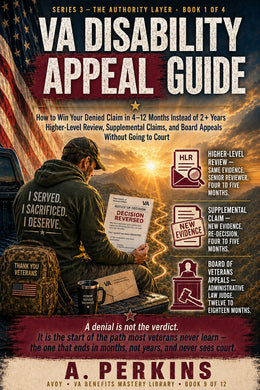
A VA denial letter starts a one-year clock, and the lane chosen inside that year shapes both the wait and the back pay. VA reported an average of 58.8 days to complete a Supplemental Claim for disability compensation or pension benefits in July 2026, while the published goal for a Higher-Level Review is an average of 125 days. Those are two very different timelines, and they answer two very different questions. Many veterans pick the wrong lane, wait months, and land back where they started with the effective date broken. This guide lays out the 2026 rules for both options so the decision rests on evidence, not guesswork.
Key Takeaways
- Choose a Supplemental Claim for new evidence, a Higher-Level Review for VA error.
- File within one year of the decision letter date to protect the effective date.
- Submit VA Form 20-0995 for a Supplemental Claim, VA Form 20-0996 for a Higher-Level Review.
- Skip the Higher-Level Review lane when new evidence exists; reviewers cannot consider it.
- Request the informal conference only when a specific error can be named.
- Reserve the single Higher-Level Review, since it cannot follow a prior one on the same issue.
Table of Contents
- Which Lane a Veteran Actually Qualifies For
- The Evidence Test That Decides the Lane
- Speed, Back Pay, and the Strategy Trade-Off
- Filing Each Review, Step by Step
- After Filing: Outcomes, Errors, and the Next Move
 | From the AVOY VA Benefits Mastery Library The VA Disability Appeal Guide covers this in full depth, with step-by-step guidance for exactly this situation. Get the Book → |
Which Lane a Veteran Actually Qualifies For
The frustration usually starts the same way. A decision letter arrives, the reasoning looks wrong, and the next screen on VA.gov offers three doors with no plain explanation of which one fits. Eligibility, not preference, closes most of that confusion quickly.
A Supplemental Claim is available to any veteran or beneficiary whose claim VA already decided, as long as the claim is not a contested claim. On top of that, at least one of two conditions must be true: new and relevant evidence is ready to submit or identify, or the claim qualifies for review because the law changed. VA specifically names the PACT Act as a change-in-law trigger, and notes the law added more than 20 presumptive conditions for burn pits, Agent Orange, and other toxic exposures.
A Higher-Level Review carries tighter gates. The request must reach VA within one year of the decision on the initial claim or Supplemental Claim, measured from the date printed on the decision letter. No new evidence can be attached. The claim cannot be a contested claim. Certain benefit types carry deadlines shorter than one year, and the decision letter states the actual deadline for that case.
The Two Bars That Close the Higher-Level Review Lane
Two rules quietly disqualify a large number of veterans. First, a Higher-Level Review cannot be requested after a previous Higher-Level Review on the same issue. Second, it cannot be requested after a Board Appeal on the same issue. A veteran who already used either of those doors on a condition has one remaining path at the regional level: a Supplemental Claim with new and relevant evidence. Reading the full decision history before choosing a form prevents a rejected request and the lost months that follow it. Pulling the claims file first makes that history visible in one place.
The Evidence Test That Decides the Lane
Most veterans want a rule they can apply in five minutes. Here it is: look at what would change the outcome. If the answer is a document VA has never seen, the lane is a Supplemental Claim. If the answer already sits in the claims file and VA read it wrong, the lane is a Higher-Level Review. VA states the position plainly, noting that a higher-level reviewer considers the same evidence as before and cannot consider anything new.
That distinction resolves most denials. A denial saying the file lacks a current diagnosis, a nexus opinion, or evidence of severity is an evidence problem. A denial that lists the right evidence but applies the wrong rating criteria, ignores a favorable opinion already in the record, or misstates a service date is an error problem. The pain point is that decision letters rarely label which one occurred, so the reasoning section has to be read line by line.
What VA Counts as New and Relevant
VA defines new evidence as information it has not considered before, and relevant evidence as information that proves or disproves something in the claim. Both parts must be present. A second copy of a treatment note already in the file is not new. A recent private evaluation, a medical opinion linking the condition to service, or a buddy statement describing an in-service event can satisfy both. Evidence can also be identified rather than submitted, and VA can help gather records once the facility name and treatment dates are supplied.
When a Change in Law Replaces Evidence
The change-in-law route works differently. For a condition that became presumptive under the PACT Act, service connection does not have to be proven the usual way. Medical evidence documenting diagnosis and severity is still needed, but qualifying service establishes the exposure presumption. Veterans denied years ago for a condition now on the presumptive list often qualify without a single new medical opinion.
Speed, Back Pay, and the Strategy Trade-Off
Timelines drive real decisions, because rent does not pause while a claim sits in queue. VA's published goal for completing a Higher-Level Review that is not related to health care benefits is an average of 125 days, roughly four to five months. The goal for Supplemental Claims is the same 125 days, but recent performance has run well ahead of it, with VA reporting an average of 58.8 days for disability compensation and pension Supplemental Claims in July 2026.
Speed is not the only variable. A Higher-Level Review requires no new development, which is why it can move quickly when the error is clean and obvious. A Supplemental Claim triggers VA's duty to assist, meaning VA helps gather the identified records, and that assistance is often the difference between a second denial and a grant. Complex Supplemental Claims that require a new examination or federal record requests naturally run longer than the average.
Protecting the Effective Date Under 38 CFR 3.2500
Back pay is where the wrong choice costs the most. Under 38 CFR 3.2500, when a claimant continuously pursues an issue by filing an available review option within one year of each decision, the effective date is fixed by the date of the original claim or the date entitlement arose, whichever is later. Break that one-year chain and continuous pursuit ends, which can reset the effective date to the later filing and erase months or years of retroactive compensation. VA states the rule directly in its own guidance: a Supplemental Claim may be filed at any time, but filing within one year of the decision letter is what preserves the effective date. That single sentence is worth more than most filing tips combined. A Higher-Level Review carries the same one-year requirement, which is why the calendar date on the decision letter belongs at the top of every appeal file.
Filing Each Review, Step by Step
Paperwork errors sink otherwise winnable reviews. The sequence below applies to either lane and keeps the one-year clock intact.
- Date the clock. Locate the date printed on the decision letter, not the date it was opened, and mark the one-year deadline on a calendar.
- Read the reasons and bases section. Identify whether the denial rests on missing evidence or on a misapplication of the evidence already present.
- Pick the matching form. VA Form 20-0995 for a Supplemental Claim, VA Form 20-0996 for a Higher-Level Review, VA Form 10182 for a Board Appeal.
- List each disputed issue separately with its decision date, and keep all listed issues inside the same benefit type, since a separate form is required for each benefit type.
- Submit and confirm receipt, then track status through the VA claim status tool rather than waiting on mail.
Filing a Supplemental Claim (VA Form 20-0995)
Disability compensation Supplemental Claims can be filed online. Other benefit types go by mail, in person, or through an accredited representative. Disability compensation forms mail to the Department of Veterans Affairs, Claims Intake Center, PO Box 4444, Janesville, WI 53547. When VA is being asked to collect private treatment records, VA Form 21-4142 must accompany the filing so the provider can release them. One caution VA highlights: a worsening condition that already carries a rating is not a Supplemental Claim, it is a claim for increased compensation.
Requesting a Higher-Level Review (VA Form 20-0996)
Online filing is available for disability compensation only. Section III selects the benefit type, and section V lists every disputed issue with its decision date. Item 16A on the PDF requests the optional informal conference. Attaching evidence to this form is counterproductive, since the reviewer cannot consider it, and the presence of new evidence signals that a different lane fits better.
After Filing: Outcomes, Errors, and the Next Move
Waiting without knowing what can happen next is its own kind of stress. Both lanes produce a new decision letter, and both have a small number of predictable endings.
A Higher-Level Review ends one of three ways. The reviewer may find the prior decision correct. The reviewer may disagree with it and decide in the veteran's favor. Or the reviewer may find that VA failed to help gather needed evidence, which is called a duty-to-assist error. A Supplemental Claim ends with a grant, a continued denial, or a request for more information. In either lane, a scheduled examination should never be missed, since a no-show can be decided on the existing record.
The Duty-to-Assist Error Outcome
The duty-to-assist finding is the quiet win inside a Higher-Level Review. VA is required to help gather evidence supporting a claim. When a higher-level reviewer determines that VA did not meet that obligation, VA lists the corrective steps, gathers the missing evidence, and decides the case on that new record. It is the one path by which a no-new-evidence lane still produces new evidence. If an informal conference is requested, the reviewer makes two attempts to reach the veteran or representative before deciding without it.
What Comes After Each Decision
Following a Higher-Level Review decision, the remaining options are a Supplemental Claim with new and relevant evidence or a Board Appeal. Following a Supplemental Claim decision, all three doors remain open: another Supplemental Claim with more new evidence, a Higher-Level Review, or a Board Appeal. VA's goal for Board Appeals on the Direct Review docket is an average of 365 days, with longer averages for the Evidence Submission and Hearing dockets. Once more than one year has passed since a decision, the only remaining option is a Supplemental Claim.
Ready to Choose Your Lane With Confidence?
The difference between a Higher-Level Review and a Supplemental Claim is not paperwork preference. It is a read of the denial letter, the evidence file, and the calendar. Veterans who make that read correctly protect their effective date and shorten the road back to a decision. Take the Free VA Claim Readiness Test at avoyvet.com to see where the current file stands, then ask AVOY Veteran Navigator AI™ for educational guidance on denials, evidence gaps, appeal lanes, and next steps built from the AVOY VA Benefits Mastery Library.
Frequently Asked Questions
Can both a Higher-Level Review and a Supplemental Claim be filed at the same time?
Not on the same issue. Each disputed issue moves through one review lane at a time, and a Higher-Level Review excludes new evidence, so pairing it with an evidence filing works against itself. Veterans with several denied conditions can route different issues differently. One condition denied for a missing nexus opinion can take the Supplemental Claim route while a separate condition rated under the wrong diagnostic code goes to a Higher-Level Review. Each lane requires its own form, and all issues listed on one form must fall under the same benefit type. Confirm current filing rules on VA.gov before submitting parallel requests.
What happens if new evidence is mailed with a Higher-Level Review?
The higher-level reviewer cannot consider it. VA decides a Higher-Level Review on the evidence already of record, and the form instructions direct veterans not to submit evidence with the request. Sending records anyway does not create an error VA must fix, and it does not convert the filing into a Supplemental Claim. The practical cost is time: months pass, the decision returns on the old record, and the evidence still has not been reviewed. When useful new records exist, the Supplemental Claim lane both accepts them and activates VA's duty to assist in gathering more.
Does filing a Supplemental Claim after one year lose the back pay?
It can. A Supplemental Claim may be filed at any time, with no absolute deadline. What expires is continuous pursuit. Under 38 CFR 3.2500, filing an available review option within one year of each decision keeps the effective date anchored to the original claim date or the date entitlement arose. When VA receives the Supplemental Claim after that one-year window, continuous pursuit is broken and a later effective date generally applies, unless VA grants an extension for good cause. The claim can still be won after one year; the retroactive period attached to it is what shrinks.
Is an informal conference worth requesting?
It depends on preparation. The informal conference is an optional one-time phone call with the assigned higher-level reviewer, used to point out factual or legal errors in the decision. It is not a hearing, and no new evidence can be presented. VA cautions that requesting one may lengthen the review, and suggests submitting a written statement identifying the errors as a faster alternative. The call is most valuable when a specific, nameable error exists, such as a misapplied diagnostic code or an overlooked opinion already in the file. It adds little when the underlying issue is simply missing evidence.
Which lane fits a PACT Act denial from several years ago?
Generally a Supplemental Claim under the change-in-law provision. VA allows a Supplemental Claim based on a change in law, and specifically names the PACT Act, which added more than 20 presumptive conditions for burn pits, Agent Orange, and other toxic exposures along with new presumptive locations. A veteran denied before the condition became presumptive does not need to re-prove that service caused it. Medical evidence documenting the diagnosis and severity is still required, and the qualifying service requirements for the presumption must be met. Verify current presumptive lists and service requirements on VA.gov, since they have been expanded more than once.
What does a duty-to-assist error mean in practice?
VA is required to help gather evidence supporting a claim. A duty-to-assist error means VA did not meet that obligation before deciding, for example by failing to request identified treatment records or failing to schedule a needed examination. When a higher-level reviewer identifies one, VA lists the corrective steps, collects the missing evidence, and issues a new decision based on that expanded record. For the veteran, it functions like a second chance without a new filing. It is also a reason the Higher-Level Review lane occasionally succeeds even when the original denial looked evidence-based rather than error-based.
Can a Higher-Level Review be requested twice on the same condition?
No. VA does not permit a Higher-Level Review after a previous Higher-Level Review on the same issue, and it does not permit one after a Board Appeal on the same issue. After a Higher-Level Review decision, the remaining options for that issue are a Supplemental Claim with new and relevant evidence or a Board Appeal before a Veterans Law Judge. This is why the lane sequence matters as much as the lane itself. Spending the single Higher-Level Review on a weak error argument removes it permanently, so it is worth reserving for a denial with a clear, identifiable mistake in the reasoning.
Educational information only — not legal, medical, or claim representation, and not affiliated with the U.S. Department of Veterans Affairs. For help filing or appealing, contact a VA-accredited VSO (often free), claims agent, or attorney. For current rates, forms, and deadlines, see VA.gov.