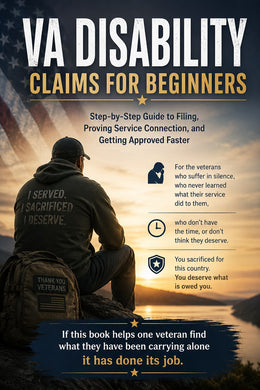
As of late May 2026, the VA is deciding disability claims in an average of 78.6 days, down from 141.5 days at the start of last year, according to VA's own June 2026 numbers. That is real progress, but it does not help you if you do not know where to start. Most first-time filers freeze right at the beginning: which form, which records, which order. One wrong first move can cost you months of back pay you never get back. This guide walks you through the exact sequence experienced filers use, so your first claim is built right the first time, not fixed after a denial.
Key Takeaways
- Submit an Intent to File (VA Form 21-0966) immediately to lock in your effective date before you have anything else ready.
- Build every claim around the Three Foundations: a current condition, an in-service event, and a nexus connecting them.
- Gather your DD-214, service treatment records, and current medical records before you touch the application form.
- Write a personal statement (VA Form 21-4138) that describes your worst day, not your best day.
- File all your conditions together in one package instead of one claim at a time.
- Choose your filing lane on purpose: VA.gov directly, or a free accredited Veterans Service Officer.
Table of Contents
- What a VA Disability Claim Actually Is
- Before You File: Locking In Your Effective Date
- Building Your Evidence Foundation
- Filing the Claim: VA.gov, VSO, or Both
- What Happens After You Submit
 |
From the AVOY VA Benefits Mastery Library VA Disability Claims for Beginners walks you through this entire process in full detail, with worksheets and real examples. Get the Book → |
What a VA Disability Claim Actually Is
A VA disability claim is a formal request for the VA to recognize that a current health condition is connected to your military service, and to assign it a rating that drives monthly, tax-free compensation. It is easy to confuse a claim with an appeal, but they are different tools for different stages. A claim is your first ask; an appeal only comes after the VA has already issued a decision you disagree with. Understanding this distinction early keeps you from wasting time on the wrong process, and it keeps you from panicking and filing an "appeal" before you have even received a decision to disagree with.
The VA is not scoring how badly you were injured in some abstract sense. It is answering one specific question: how has your time in uniform affected your health today? That framing matters, because it tells you what evidence actually counts. A condition that started in service, or was caused or worsened by service, is what the system is built to recognize — not just severity on its own. A veteran with a mild condition that is clearly connected to service is in a stronger position than a veteran with a severe condition that has no documented tie to their time in uniform.
The Three Foundations of Every Claim
Every successful direct-service-connection claim rests on three pillars: a current diagnosis, an in-service event, injury, or exposure, and a nexus — a documented link tying the two together. Miss any one of the three and a direct claim generally cannot be granted. Have all three, clearly supported, and the VA has a legal obligation to recognize the connection. It is not a favor or a courtesy; it is simply how the rule works. Before you file anything, walk through each condition you are claiming and confirm you can point to evidence for all three pillars.
Claim vs. Appeal: Why the Order Matters
Filing before you are ready, or trying to "appeal" something that has not been decided yet, both waste time and confuse the system's timeline for your case. Get your first claim as complete as possible on the front end. It is far more efficient to build a strong package once than to file thin and spend a year fixing gaps through appeals later, since appeals generally take considerably longer than a well-prepared initial claim.
Before You File: Locking In Your Effective Date
The single highest-leverage form in the entire VA system is the Intent to File, VA Form 21-0966. It takes about ten minutes to submit and locks in your effective date for up to twelve months while you gather the rest of your evidence. If your claim is later approved, your back pay is calculated from that locked date, not from whenever you finally finish your paperwork and formally submit your application.
File your Intent to File the same day the idea of filing occurs to you. There is no downside to submitting it early, and every day you wait before submitting it is a day of potential back pay you cannot recover later, even if you end up waiting months to actually finish gathering your evidence. This single step is often the difference between a veteran who collects thousands of dollars in retroactive pay and one who simply loses that window permanently.
Why Veterans Skip This Step — and Why It Costs Them
Many first-time filers assume they need to have everything ready before they file anything at all. That assumption is expensive, and it is also unnecessary. The Intent to File exists precisely so you do not have to choose between filing fast and filing complete. Submit it first, immediately, then take the time you actually need to build a strong, well-documented evidence package behind it, without the pressure of an artificial deadline.
What the Intent to File Does Not Do
An Intent to File is not the claim itself, and submitting one does not start the VA's formal review process. It is a placeholder that protects your effective date while the clock quietly runs in the background. You still need to file the actual application, VA Form 21-526EZ, within the twelve-month window for that locked-in effective date to hold and actually apply to your eventual award.
Building Your Evidence Foundation
Before you touch the application form, assemble your evidence. Start with your DD-214, which nearly every downstream step depends on and which most VA processes will ask for first. Add your service treatment records, current diagnosis and treatment records, and — where the connection to service is not obvious on its own — a nexus opinion from a qualified provider. Lay statements from people who witnessed relevant events, including fellow service members, family, or friends, can fill gaps that official records often miss entirely.
List every condition you believe is connected to your service, not just the most obvious one. Filing one claim at a time is one of the most common and costly mistakes first-time filers make, because each new filing effectively restarts a portion of the review clock. Building your evidence for every condition in parallel and submitting one consolidated package is far more efficient than filing repeatedly over months or years, and it lets the VA see your full picture at once instead of piecemeal.
Naming Your Conditions Precisely
Vague condition names slow claims down and can lead a rater to request more information before moving forward. "Back problems" gives a rater almost nothing to work with; "chronic lumbar disc disease at L4-L5" gives them something specific they can actually evaluate directly against your medical records. Be as specific as your medical records allow, and use the same terminology your treating providers use in their own documentation.
The Personal Statement That Actually Helps
VA Form 21-4138, your personal statement, is where you describe how your condition affects daily life in your own words, in your own voice. Describe your worst day, not your average day, and be concrete: what you could not do, how it affected work, sleep, or relationships. Raters cannot see what you deal with day to day unless you tell them clearly, specifically, and honestly.
Filing the Claim: VA.gov, VSO, or Both
Once your evidence is organized, you have two main lanes for actually filing: submitting directly through VA.gov, or working with a free accredited Veterans Service Officer. Filing directly on VA.gov is generally the fastest and most trackable route, since you can see your claim's status in real time rather than waiting on a third party to check and relay updates to you on their own schedule.
A free accredited VSO can be valuable if you want a second set of eyes on your package, help navigating a complicated case, or simply someone experienced to walk through the process with you. Either path is legitimate and can lead to a strong outcome; the key is deciding deliberately, based on your own comfort with paperwork, rather than defaulting to whichever option happens to be easiest at the moment you finally sit down to file.
Completing VA Form 21-526EZ
This is your formal Application for Disability Compensation. List every condition from your evidence-gathering step, attach your supporting documents, and submit your personal statement alongside it in the same package. Incomplete entries, missing conditions, or vague descriptions here are among the most common reasons claims stall partway through review instead of moving smoothly forward. Double-check that every condition you gathered evidence for actually appears on the form itself — it is surprisingly common for a veteran to prepare records for one condition and then forget to list it in the application.
Filing All Your Conditions Together
Submitting one comprehensive package covering every condition you have evidence for — instead of filing one condition, waiting for a decision, then filing another — keeps your claim moving through the system as a single coordinated case rather than several disconnected ones competing for separate attention and separate review cycles. It also means you only go through the C&P exam scheduling process once for related conditions where that is possible, instead of repeating the wait each time you file something new months apart.
What Happens After You Submit
After you file, your claim moves through the VA's review stages, and your evidence is matched against the Three Foundations for each condition you have listed. You may be scheduled for a Compensation and Pension exam, where an examiner evaluates your current condition in person or by video and compares it against your submitted records and personal statement. Prepare for this exam the same way you prepared your personal statement: describe your worst day, your actual limitations, and how your condition affects your daily functioning — not a minimized version of your symptoms that undersells what you actually experience.
Track your claim status through VA.gov or the VA Health and Benefits app, both of which show real-time updates as your claim moves between stages. If the VA requests additional information, respond promptly, since delays in responding to evidence requests are one of the most preventable causes of a slower decision. With average processing times now well under half of what they were at the start of last year, a complete, well-organized claim filed today has a real chance of moving through the system meaningfully faster than veterans have experienced in years.
Your claim moves through several internal stages: claim received, under review, gathering of evidence, evidence review, preparation for decision, pending decision approval, and finally preparation for notification. Seeing your claim sit in "gathering of evidence" for a while is normal, not a red flag by itself — that is simply the stage where the VA is requesting your service and medical records from other agencies, which can take time depending on how those records are stored. What matters more than the stage label is whether your own response items are complete. If the portal shows a request for information sitting in your queue, treat it as time-sensitive rather than something to revisit later, since an unanswered request is one of the few things genuinely within your control at this point in the process.
Ready to Find Out Where You Stand
Filing your first VA claim does not have to feel like guesswork. Lock in your effective date with an Intent to File, build your evidence around the Three Foundations, and file every condition together in one organized package. That is the difference between a claim that moves smoothly and one that stalls for months waiting on requests you could have anticipated.
Not sure if your evidence package is ready? Take the Free VA Claim Readiness Test at avoyvet.com to see where your claim stands before you file — and get a clear next step for your situation.
Frequently Asked Questions
What is the very first thing I should do before filing a VA disability claim?
Submit an Intent to File, VA Form 21-0966, before you do anything else. It takes about ten minutes and locks in your effective date for up to twelve months, which is what your back pay gets calculated from if your claim is eventually approved. You do not need any evidence gathered yet to submit it — it is simply a placeholder that protects your date while you prepare the rest of your claim behind it. Many veterans lose months of potential back pay simply because they waited to file this form until their evidence was fully organized, when the two steps do not need to happen in that order at all. File it the same day the idea occurs to you, then build your case at your own pace.
What is the difference between a VA claim and a VA appeal?
A claim is your first request asking the VA to recognize a condition as connected to your service and assign it a rating. An appeal is a separate process that only becomes available after the VA has issued a decision you disagree with. You cannot appeal something that has not been decided yet, and treating your first filing like an appeal usually means missing information the VA actually needed to grant it in the first place. Focus your energy on building the strongest possible initial claim rather than assuming you can simply fix gaps later through an appeal, since appeals typically add significant additional time before you see a resolution either way.
Do I need a nexus letter for every condition I claim?
Not necessarily. A nexus is required when the connection between your current condition and your military service is not already obvious from your records. If your service treatment records clearly document the injury or exposure and your current diagnosis is a direct continuation of it, the link may already be sufficiently documented without anything additional from a provider. For less obvious connections, such as a condition that developed gradually or years after discharge, a nexus opinion from a qualified medical provider is usually necessary to establish the missing link clearly enough for a rater to approve the claim on its merits. When in doubt, ask your treating provider directly whether they are willing to put the connection in writing.
Should I file my claim myself or use a Veterans Service Officer?
Both are legitimate paths, and neither is inherently better for every veteran. Filing directly through VA.gov is typically the fastest and most trackable option, since you can monitor your claim's status in real time without waiting on anyone else. A free accredited VSO can help if you want assistance organizing a complex claim, a second set of eyes before you submit, or simply someone to walk you through unfamiliar paperwork. The best choice depends on your comfort level with paperwork and how complicated your specific situation is — either lane can produce a successful outcome if the underlying evidence package is genuinely strong.
Why do I need to list every condition at once instead of filing one at a time?
Filing conditions one at a time means restarting portions of the evidence-gathering and review process repeatedly, which can stretch what should be a single filing effort across many months or even years of separate submissions. Building your evidence for every condition you have a credible connection for, then submitting one consolidated package, lets the VA evaluate your full picture at once rather than in scattered pieces spread across separate filings made months or years apart. This approach is also simply more efficient for you personally, since you are not repeating the same preparation work, the same records requests, and the same waiting periods for each condition separately, one after another.
What should I say at my Compensation and Pension exam?
Describe your condition on your worst day, not your best day, and be specific about how it limits your daily functioning — sleep, work, mobility, concentration, or relationships with family and friends. Examiners are evaluating your current condition against your claimed history and your personal statement, and understating your symptoms out of pride, habit, or a desire to appear tough can result in a lower rating than your actual condition genuinely supports. Be honest, thorough, and specific rather than minimizing what you actually experience day to day, since the exam is one of the few chances a rater has to see your condition described in real detail.
What's the most common mistake first-time filers make?
Filing without submitting an Intent to File first, which can cost months of retroactive back pay that can never be recovered once that window has closed and your effective date defaults to the actual filing date. Close behind that is filing vague condition descriptions instead of specific medical terminology, and filing one condition at a time instead of building a complete, consolidated package covering everything at once. Each of these mistakes is fully preventable with a small amount of preparation before you ever touch the application form, which is exactly why building your evidence foundation first matters just as much as the act of filing itself.