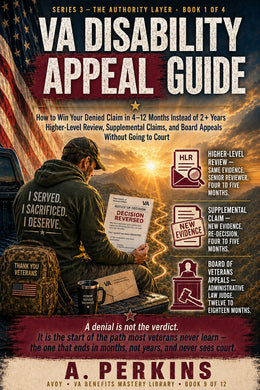
The Board of Veterans' Appeals reported that veterans on its Direct docket waited an average of just 212 days for a decision as of March 2026 — down from over 900 days at the peak in mid-2024. That is welcome news for veterans who have already been denied once and are bracing for another long wait. But "how long" still depends entirely on which of the Board's three review lanes a veteran chooses, and picking the wrong one can add a year or more to the process. This guide breaks down eligibility, evidence, docket choice, and the step-by-step filing process so veterans can choose the lane that actually fits their case.
Key Takeaways
- Understand that a Board Appeal is only available within 1 year of a decision on an initial claim, Supplemental Claim, or Higher-Level Review.
- Choose between three dockets — Direct Review, Evidence Submission, or Hearing — before filing, since you cannot switch later without starting over.
- Gather new evidence before filing if choosing Evidence Submission, since it must arrive within 90 days of the Board receiving the appeal.
- Expect current 2026 wait times of roughly 212 days on Direct Review and 260 days on Evidence Submission, both well under the Board's published goals.
- File VA Form 10182 online, by mail, by fax, in person, or with an accredited representative — five ways to start the same process.
- Plan your next move before the decision arrives: a Supplemental Claim with new evidence or a Court Appeal within 120 days are the only options after a Board denial.
Table of Contents
- Who Qualifies for a Board Appeal
- Evidence That Strengthens Your Board Appeal
- Choosing Your Docket: Direct Review, Evidence Submission, or Hearing
- How to File VA Form 10182, Step by Step
- After You File: 2026 Wait Times and What Happens Next
- Frequently Asked Questions
 |
From the AVOY VA Benefits Mastery Library The VA Disability Appeal Guide covers this in full depth, with step-by-step guidance for exactly this situation. Get the Book → |
Who Qualifies for a Board Appeal
A Board Appeal is not the first stop after a VA decision — it is one of three decision-review paths available under the Appeals Modernization Act (AMA), alongside a Supplemental Claim and a Higher-Level Review. According to VA.gov, a veteran can request a Board Appeal only after receiving a decision on an initial claim, a Supplemental Claim, or a Higher-Level Review, and cannot request two Board Appeals in a row on the same issue. The pain point for most veterans at this stage is timing pressure: after already waiting months for a first decision, the idea of starting another multi-month process can feel discouraging, especially without a clear sense of the odds or the calendar involved.
The 1-Year Filing Window
The Board's own published rule is firm: a completed VA Form 10182 must be postmarked or received within 1 year (365 days) from the date on the decision letter being appealed. There is one narrow exception — contested claims, where two people are claiming the same benefit, must be appealed within 60 days instead of a year. Missing the 1-year window generally means starting over with a new Supplemental Claim rather than continuing the same appeal, so veterans should mark the deadline the day the decision letter arrives, not the day they decide to appeal.
Eligibility is also shaped by what a veteran is appealing. A Board Appeal can address a single denied condition, a disagreement over an assigned rating percentage, an effective date dispute, or a Board Appeal from a prior review — the form asks veterans to list every issue and decision date being contested, so accuracy on that section matters as much as meeting the deadline itself.
Evidence That Strengthens Your Board Appeal
The evidence a veteran submits — or chooses not to submit — is what separates the three Board dockets from one another, and it drives how a Veterans Law Judge evaluates the case. The Board adjudicated more than 35,000 Evidence docket appeals for veterans and dependents between April and December 2025 alone, according to the Board's own decision-wait-times report, which reduced that docket's backlog by 67% in less than a year. That volume shows how central new evidence has become to the modern appeals system, but it only helps if it is relevant, specific, and submitted on time.
New Evidence vs. the Existing Record
On the Direct Review docket, a Veterans Law Judge decides based solely on what is already in the claims file — no new evidence is accepted, and no hearing is held. On the Evidence Submission docket, new evidence must be submitted with the appeal itself or within 90 days of the date the Board receives the request. On the Hearing docket, new evidence can be added at the hearing or within 90 days afterward. Choosing Direct Review when the existing record is thin, or choosing Evidence Submission without anything new to add, wastes the docket's core advantage.
Lay Statements and Nexus Support
New evidence does not always mean a new medical test. Buddy statements from fellow service members, updated private treatment records, a more detailed personal statement describing symptoms at their worst, and an independent medical opinion (IMO) addressing service connection can all qualify as new evidence for the Evidence Submission or Hearing dockets. For PACT Act presumptive conditions, confirming that toxic exposure and diagnosis dates fall within the recognized presumptive window is often the single most useful addition to a Board Appeal file.
Choosing Your Docket: Direct Review, Evidence Submission, or Hearing
VA.gov publishes a specific decision goal for each of the three dockets: 365 days for Direct Review, 550 days for Evidence Submission, and 730 days for Hearing. Those goals exist because each docket trades speed for a different kind of case-building opportunity, and the pain point veterans run into is picking a docket based on which sounds fastest rather than which fits the actual gap in their case file.
Comparing the Three Lanes
Direct Review fits veterans who believe the existing record already supports their claim and simply want a judge to take a fresh look without delay. Evidence Submission fits veterans who have specific new documents — a nexus letter, updated records, a buddy statement — ready to submit without needing to testify. Hearing fits veterans who want to explain their case directly to a Veterans Law Judge, whether by virtual tele-hearing, videoconference at a nearby VA location, or in person in Washington, D.C. A hearing adds a second waiting line for scheduling on top of the review itself, which is why it carries the longest published goal of the three.
There is no penalty for choosing the slower, more thorough docket if it is the right one for the case — a denial after a rushed Direct Review with a thin record often leads right back into another appeal, erasing whatever time was saved.
How to File VA Form 10182, Step by Step
Filing a Board Appeal means completing VA Form 10182, Decision Review Request: Board Appeal (Notice of Disagreement). VA.gov lists five ways to submit it, giving veterans flexibility based on how they prefer to handle paperwork.
Before You Submit
Confirm the exact decision date on the letter being appealed, list every issue in dispute by name, and decide on a docket type before starting the form — switching dockets after submission is not an option. Gather any new evidence now if choosing Evidence Submission, since the 90-day clock starts when the Board receives the request, not when the evidence is ready.
The 5 Filing Steps
- Get the form. Download VA Form 10182 from VA.gov, request a copy at a VA regional office, or call 800-827-1000 to have one mailed.
- Choose a docket. Select Direct Review, Evidence Submission, or Hearing on the form — this decision cannot be changed after filing.
- Complete the form. Provide identifying information, VA file number, representative details if applicable, and a specific list of the issues and decision dates being appealed.
- Sign and submit. The form is only valid with an ink signature and dated Item 13. Submit online at VA.gov (the fastest option), by mail to Board of Veterans' Appeals, PO Box 27063, Washington, D.C. 20038, by fax, or in person at a VA regional office.
- Track your status. Once the Board adds the case to its docket, check progress anytime through the VA claim-or-appeal status tool at VA.gov.
After You File: 2026 Wait Times and What Happens Next
Filing is the start of the wait, not the end of the process, and knowing the current numbers helps veterans set realistic expectations instead of relying on outdated horror stories from the Board's Legacy-system years. As of March 2026, the Board reported Average Days Pending of 212 days on the Direct docket and 260 days on the Evidence docket — both comfortably under their 365-day and 550-day goals — while the Hearing docket is following the same downward trend after peaking in January 2026.
Current Board Wait Times by Docket (2026)
These figures reflect how long veterans with cases already pending have been waiting, not just how fast recently decided cases moved. The Board attributes the improvement to a multi-year staffing increase authorized by Congress between FY 2022 and FY 2024, which allowed it to issue 108,134 AMA decisions in FY 2025 alone — more than four times its FY 2021–2023 annual average. Veterans should still expect variation month to month, since the Board is actively working through its oldest pending cases first on each docket.
If You Disagree with the Board's Decision
A Board decision is not always the final word. If new and relevant evidence exists that was not part of the record, a veteran can file a Supplemental Claim. Alternatively, a veteran can appeal to the U.S. Court of Appeals for Veterans Claims (CAVC) within 120 days of the date on the Board's decision letter — that appeal goes to the federal court, not back to VA. Understanding both paths before a decision arrives means there is no scramble against the clock if the outcome is unfavorable.
Every Board Appeal starts with an honest look at where a case stands today. The Free VA Claim Readiness Test at avoyvet.com walks veterans through their current claim status and helps identify which decision-review option — Supplemental Claim, Higher-Level Review, or Board Appeal — actually fits their situation before a form gets filed.
Frequently Asked Questions
How long does a Board Appeal take in 2026?
It depends entirely on the docket chosen. As of March 2026, the Board reported Average Days Pending of 212 days for veterans on the Direct Review docket and 260 days on the Evidence Submission docket, both well under their published 365-day and 550-day goals. The Hearing docket remains the slowest of the three, with a published goal of 730 days, though the Board reports that docket is now following the same downward trend the other two dockets already experienced. These are averages across all pending cases, not guarantees for any individual appeal, so actual timing can vary based on case complexity and current docket volume.
What's the difference between Direct Review, Evidence Submission, and Hearing dockets?
Direct Review has a Veterans Law Judge decide based only on the evidence already in the file — no new evidence, no hearing, and the fastest published goal at 365 days. Evidence Submission allows new evidence submitted with the appeal or within 90 days afterward, with no hearing, and a 550-day goal. Hearing includes a meeting with a Veterans Law Judge (virtual, videoconference, or in-person), allows new evidence at or within 90 days after the hearing, and carries the longest goal at 730 days. Once selected, the docket type cannot be changed for that appeal.
Can I submit new evidence to the Board?
Only on the Evidence Submission and Hearing dockets. On Evidence Submission, new evidence must be submitted with the appeal request or within 90 days of the date the Board receives it. On the Hearing docket, new evidence can be submitted at the hearing itself or within 90 days after it concludes. The Direct Review docket does not accept any new evidence at all — the judge works exclusively from the existing record, which is why it is best suited to cases where the file is already complete.
Do I need a lawyer or VSO for a Board Appeal?
No, but representation is an option at every stage. Veterans can file VA Form 10182 on their own, or with help from an accredited attorney, claims agent, or Veterans Service Organization (VSO) representative. Many VSOs assist with Board Appeals at no cost. A representative can help select the right docket, organize evidence, and communicate with the Board, but the choice to use one is entirely up to the veteran, and self-filed appeals are reviewed under the same standards.
What happens if I lose my Board Appeal?
Two options remain. If new and relevant evidence exists that was not part of the Board's record, a veteran can file a Supplemental Claim using VA Form 20-0995. Alternatively, a veteran can appeal to the U.S. Court of Appeals for Veterans Claims within 120 days of the date on the Board's decision letter, which is a federal court process separate from VA's internal review system. Choosing between the two depends on whether there is genuinely new evidence to add or whether the dispute is about how existing evidence was evaluated.
Can I request an Advance on Docket (AOD) to get a faster decision?
The Board's public reporting on wait times specifically discusses AOD (Advance on Docket) cases as a category that moves ahead of the standard queue, which is generally available for reasons such as advanced age, serious illness, or documented financial hardship. Veterans considering this route should confirm current AOD eligibility criteria and request procedures directly on VA.gov or with an accredited representative, since AOD approval is case-specific and not guaranteed.
Should I choose a Board Appeal or a Supplemental Claim instead?
It depends on what changed since the original decision. A Supplemental Claim is generally faster and is built around submitting new and relevant evidence to the same regional office that made the original decision. A Board Appeal sends the case to a Veterans Law Judge in Washington, D.C. and makes sense when a veteran disagrees with how the existing evidence was weighed, wants a hearing, or has no new evidence to add. Comparing both options against the specific gap in a case — missing evidence versus a disputed judgment call — usually points to the right choice.
Educational information only — not legal, medical, or claim representation, and not affiliated with the U.S. Department of Veterans Affairs. For help filing or appealing, contact a VA-accredited VSO (often free), claims agent, or attorney. For current rates, forms, and deadlines, see VA.gov.